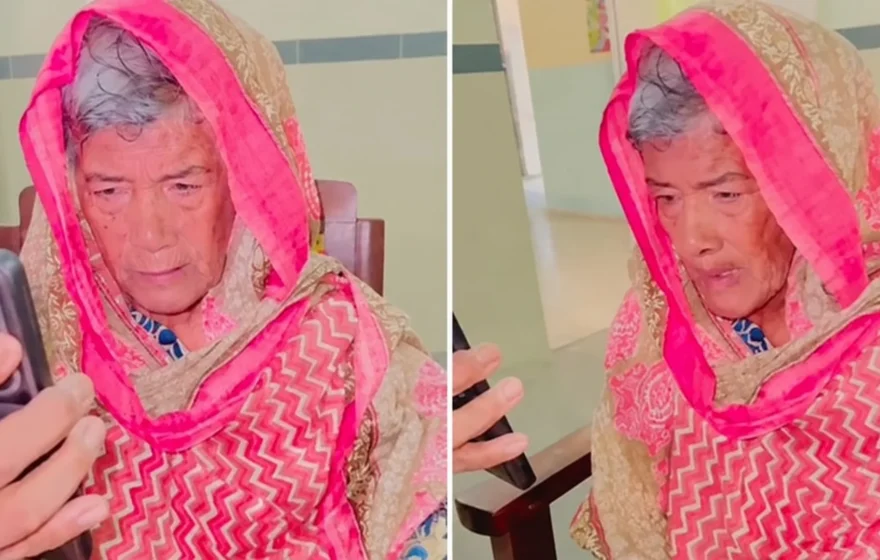
After 40 years apart, a Bangladeshi woman has been reunited with her family thanks to the efforts of the Punjab Safe Cities Authority. The woman, identified only as Halima, had been living in Pakistan without any way of telling the authorities who she was or where she came from, until a team in Lahore pieced together the few details she could remember and traced her son and nephew across the border in Bangladesh.
According to a spokesperson for the Safe City project, Halima was found alone in Islamabad in 2013. She could not speak Urdu, and without a shared language she was unable to explain her identity or give the officials any useful information about her family. She was taken to an Edhi Centre, where she was given temporary shelter, and she remained there for several years while the authorities tried to work out who she was.
The breakthrough came slowly. The Safe City team kept working on her case, coordinating with local authorities and going back over the fragments of information Halima was able to provide. She could remember the name of her ancestral village and the names of members of her family, and those details proved to be enough. Working from them, the team eventually traced her son and her nephew in Bangladesh, and contact was established between them for the first time in four decades.
The Punjab Safe Cities Authority runs the network from its Integrated Command, Control and Communication Centre in Lahore. The Lahore Safe City project was inaugurated in January 2018 by the then chief minister, Shehbaz Sharif, with 8,000 cameras installed at some 1,700 points around the city. The project was built in collaboration with the Chinese company Huawei, and it was described at the time as the biggest project of its kind in Asia.
What began in Lahore has since spread across the whole of Punjab. In August 2026, Chief Minister Maryam Nawaz inaugurated the Punjab Integrated Safe City Network, bringing Safe City facilities to 43 cities and making Punjab the first province in Pakistan to establish an integrated network across all of its 41 districts and two tehsils. The chief minister was told at the launch that the combined work of the police, the Crime Control Department and the Safe Cities Authority had contributed to an estimated 80 percent reduction in crime.
The expansion has continued since then. In September 2026, the authority launched a project to extend the digital surveillance network to 98 tehsils across the province, at an estimated cost of 16 billion rupees. The plan involves installing 10,000 new cameras and taking the network to 7,602 union councils. Officials said at the time that more than 24,000 high-definition cameras were already monitoring roads, markets, highways and public spaces in Punjab, and that the project had contributed to a 70 percent reduction in serious crime.
The cameras are only part of the system. The network now runs more than a dozen artificial intelligence systems of its own, including automatic number plate recognition, facial recognition and crime analysis tools that help the police identify stolen vehicles, spot suspicious behaviour and predict where crime is most likely to occur. The system also includes a Virtual Women Police Station, a Child Safety Virtual Centre and a Virtual Blood Bank. A further 1,500 panic buttons are to be installed across the province, and every police station is to be equipped with the facility.
For Halima, none of that technology was the point. What mattered was that someone kept her case open for years, that the details she remembered were treated as worth following up, and that the authorities on both sides of the border were willing to work together. The Edhi Centre gave her a roof over her head for the years in between. The Edhi Foundation, founded by the late Abdul Sattar Edhi, runs shelters, orphanages and welfare centres across Pakistan, and it has long been the place where people with nowhere else to go are taken in.
Language was the barrier that kept Halima separated from her family for so long. Without Urdu, she could not tell the officials in Islamabad who she was, where she had come from, or whom she had left behind. It was only when the Safe City team worked through the names she did remember, the village and the family members, that the picture began to form. That a handful of remembered names could lead, after so many years, to a son and a nephew in another country is a reminder of how much can rest on a single detail.
Reunions of this kind are rare, and they do not happen by accident. They happen because an organisation keeps a file open when it would be easier to close it, and because a few remembered names are treated as a lead rather than a dead end. In a system built to watch a province, this was a case where the watching mattered less than the listening, and where the result was measured not in arrests or fines but in a family finding each other again after 40 years.
