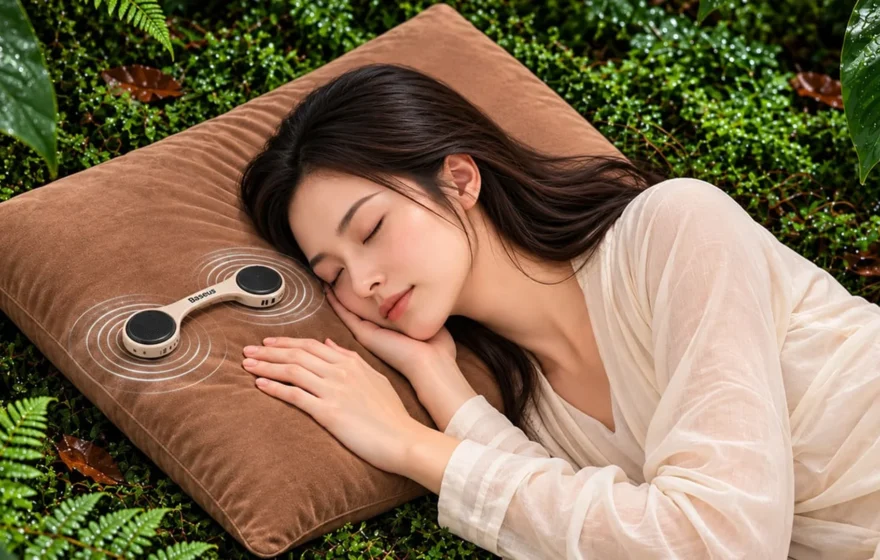
Baseus has launched a speaker with a difference. Instead of sitting on a shelf or a desk, the new Sleep SK1 is designed to slide underneath your pillow, sending music, podcasts and sleep sounds through the pillow itself so that only the person lying on it can hear them.
The Chinese accessories maker has put the device on sale in China for 184 yuan, which works out at roughly 28 dollars. There is no word yet on when it might be sold in other countries, or what it would cost outside China, but the idea behind it will be familiar to anyone who has ever tried to fall asleep to music without waking the person next to them.
The problem the Sleep SK1 is trying to solve is an old one. Earbuds can be uncomfortable to wear in bed, especially for people who sleep on their side, and they can fall out during the night. A normal speaker, on the other hand, fills the whole room with sound, which is fine if you sleep alone but less welcome if you share a bed or a bedroom. Baseus believes the answer is to put the sound inside the pillow, where it reaches one pair of ears and almost nowhere else.
Design and Audio Technology
The Sleep SK1 is a flat, slim slab that measures just 14 millimetres thick and 16.5 centimetres long, and weighs only 44 grams. At less than a centimetre and a half thick, it is meant to sit under a pillow without creating a lump the sleeper can feel, even when lying on their side. The body has a matte finish that resists fingerprints, and the casing is made from fire-resistant materials. There is also a small digital display showing the time in 24-hour format, the remaining battery level and the current operating mode, so it can double as a bedside clock.
What makes the speaker unusual is what is inside it. Instead of the conventional drivers that push air to create sound, the SK1 uses a micro-vibration transmission system with two symmetrical vibration drivers. These send sound waves through the pillow, and the pillow carries the sound the last few inches to the listener’s ear. Baseus says the system works best with pillows less than eight centimetres thick, although turning up the volume can compensate for a thicker pillow.
Bluetooth, White Noise and Sleep Features
The Sleep SK1 connects to a phone over Bluetooth 6.0, the latest version of the wireless standard, and can stream music, podcasts and audiobooks in the usual way. It also has an offline mode, which lets the owner listen without keeping a phone connected, a useful feature for people who prefer to leave their phone in another room at night.
Through the companion app, users can choose from more than 100 white noise tracks, including the sounds of rainfall, a campfire, ocean waves, birdsong, meditation music and ASMR recordings. White noise has become a popular sleep aid in recent years, with many people finding that a steady, gentle sound helps to mask traffic, snoring and other disturbances that might otherwise wake them. The app also offers sleep timers that run from 30 to 120 minutes, so the audio can switch itself off after the listener has drifted off, and it supports up to 10 customisable alarms. Baseus says the directional nature of the sound means an alarm can wake one person without disturbing someone sleeping beside them.
Battery Life and Pricing
Inside the slim body is a 300 milliamp-hour battery, which Baseus says provides more than 10 hours of continuous playback, enough to last through a full night with charge to spare. When the battery does run down, it charges through a USB-C port and takes around two hours to reach a full charge, so it can be topped up during the day and be ready again by bedtime.
The speaker is currently listed in China on the shopping platform JD.com, where the price of 184 yuan converts to roughly 28 dollars. In some parts of China, local government subsidies for consumer electronics can bring the price down further, to as little as 173 yuan. Baseus has not said anything about international pricing or availability, so buyers outside China will have to wait to find out whether the SK1 will reach their market and what it will cost when it does.
Even so, the Sleep SK1 is an interesting sign of where personal audio is heading. As earbuds get smaller and speakers get smarter, companies are looking for new places to put sound and new ways to keep it private. A speaker that lives under a pillow is a small idea, but it solves a real problem, and at a price that makes it easy to try. If it works as well as Baseus says it does, it may not be long before the bedroom becomes the next place where the speaker disappears altogether.
