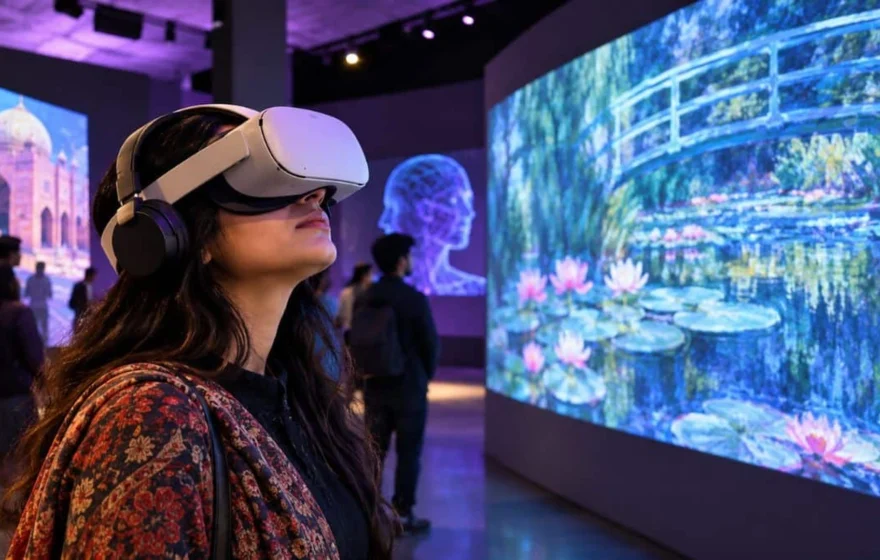
Lahore has opened the doors to a kind of art exhibition the city has never seen before. Pakistan’s first festival devoted entirely to virtual and extended reality art began on Sunday at the Alliance Française de Lahore, where visitors put on headsets instead of simply walking past framed pictures on a wall. The opening drew a full house, and the works on show come from 70 artists based in Pakistan and in countries as far apart as France, Spain, Canada and the United States.
The festival is called Between the Prompts // V.1, and its name gives away what it is about. It looks at the space between a human instruction and the image a machine produces from it, at a time when algorithms are playing a larger and larger part in how pictures and digital art are made. Rather than treating that change as a threat, the artists here work with it, question it and turn it into something visitors can step inside.
Artists From Pakistan and Abroad Take Part
The festival has been put together by Dr Najamul Assar and Sarah Rajper, with Zainab Aamir working as assistant curator. It carries the backing of the Embassy of France in Pakistan, the Alliance Française de Lahore, the Institut français, the Embassy of Spain in Pakistan and AECID, the Spanish development cooperation agency, in collaboration with UNESCO.
Sixteen artists were featured in the opening programme. Among them were Adriaan Lokman, Amna Tariq, Anusha Khalid, Asma Kazmi, Che-Kuang Chuang, Jérémy Griffaud, Jill Miller, Lola Zoido, Manel Pascual Bafaluy, Mansoor Ali, Marie Lienhard, Marion Pédebernade, Nicolas Thépot, Pierre-Alain Pédebernade, Sana Akram and Sandrine Deumier. A session where visitors could meet the artists was also held during the opening, featuring AB Rehman, Anusha Khalid, Lola Zoido, Mansoor Ali, Marie Lienhard and Sandrine Deumier.
Visitors Step Inside the Art Through VR Headsets
Unlike an ordinary exhibition, the VXR Festival does not ask visitors to stand still. The works are experienced through virtual reality headsets, display screens and augmented reality, the technology that lays digital images over the real world. A visitor wearing a headset can find herself standing inside a painting, walking through a drawn landscape, or watching a sketchbook page come alive in front of her.
That shift changes the relationship between the audience and the art. In a normal gallery, the picture stays where the artist put it and the viewer decides how long to look. Here, the viewer’s head movements and position shape what appears next. Entry is free, so students, families and the simply curious can try the headsets without paying, and for many in Lahore this will be their first time wearing one.
Old Art Meets New Technology
Several works at the festival take familiar traditions and rebuild them with new tools. The most talked-about is a virtual reality experience built around the paintings of Claude Monet, being shown in Pakistan for the first time through the Institut français collection. Visitors begin in the garden the French painter created at Giverny, and are then carried inside his Water Lilies, the great series of paintings now held at the Musée de l’Orangerie in Paris.
Pakistani artists are doing something similar with their own heritage. Sana Akram’s Sun takes the Urdu Tilismi Dastan, the old tradition of magical adventure tales told aloud over many nights, and turns it into an immersive landscape that visitors can explore while listening to its story. AB Rehman’s Al Buraq 2.0 takes a figure rooted in cultural and religious memory and places it in a setting from science fiction. Other works show how patient, handmade art can live inside digital systems: Jérémy Griffaud’s Under the Sky is built from almost 300 watercolour paintings he made in Borneo, while Faqeha Nadeem’s Every Day uses augmented reality to animate the drawings of an ordinary sketchbook.
Festival Moves From Lahore to Islamabad
After opening at the Alliance Française, the festival is continuing at other venues around Lahore, including R Space at the Mariam Dawood School of Visual Arts and Design, the National College of Arts and Beaconhouse National University, where another session is scheduled for November 12. The Lahore run continues until November 11, and then the festival travels to Islamabad, where its programme will run from November 13 to 15.
The festival is an initiative of the team behind the Lahore Digital Arts Festival, which has been promoting digital art and creative technology in Pakistan since 2019, building the audience, skills and partnerships behind an event like this. If students, teachers and young artists come away wanting to make work of their own, the festival will have done more than entertain a crowd for a few days: it will have shown that Pakistan’s art scene does not have to wait for new technology to arrive from elsewhere, and that its own stories are ready to be told in whatever medium comes next.
