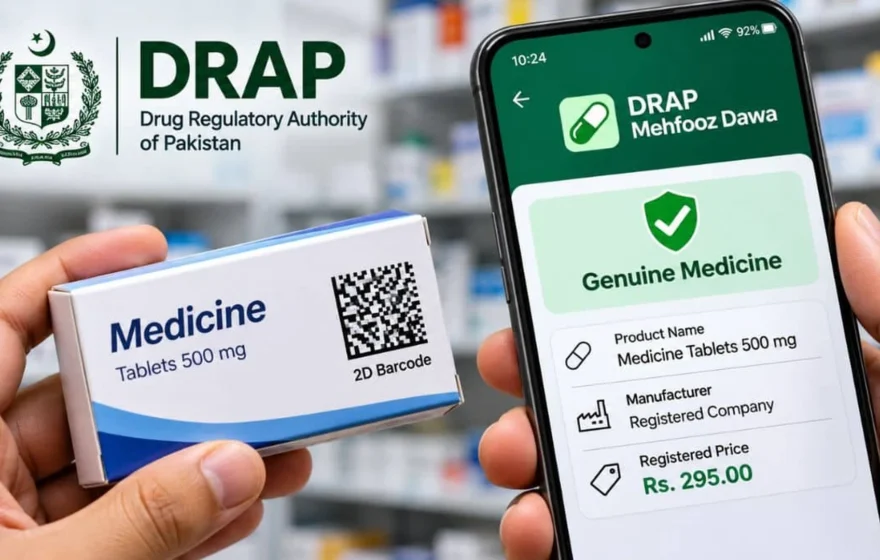
The next time you collect a prescription from a pharmacy in Pakistan, your phone may be able to tell you whether the box in your hand is genuine, and whether the price on it is the one the regulator actually fixed. The Drug Regulatory Authority of Pakistan, known as DRAP, is urging people to use its new Mehfooz Dawa app to check their medicines before they pay for them. The app scans a two-dimensional barcode on the packaging and pulls up the registered details of the product, including its price. It could matter a great deal in a country where fake and substandard drugs have long been a public health problem.
More Than 90,000 Medicines Registered With DRAP
Sajid Shah, a spokesperson for the Ministry of National Health Services, said around 800 pharmaceutical companies and more than 90,000 medicines are registered with DRAP. Every registered product now has a record in the system, and a scanned pack can be checked against it in seconds. For families buying regular medication every month, confirming authenticity at the counter could become as routine as checking the expiry date.
Medicine Track and Trace System Now Operational
The centralised Track and Trace System for medicines distributed across Pakistan became operational on October 9, 2026. From that date, registered medicines made locally or imported into the country must carry a two-dimensional barcode with a unique serial number, under the framework set out in S.R.O. 963(I)/2026. Each code carries four pieces of information: the product code, the batch number, the expiry date, and a serial number unique to that pack.
Besides helping consumers, the system lets regulators follow medicines through the supply chain, so they can see where a particular batch has been and where it was supposed to go. That could also make recalls faster and more precise: instead of warnings going out for whole brands, the exact packs involved could be identified, and patients could check their own medicine rather than guessing.
How the Mehfooz Dawa App Works
Consumers need a smartphone to use the system. They scan the 2D barcode on a medicine pack through the Mehfooz Dawa app, and the system displays details about the product and its price. The health minister said in mid-October that pharmacies, medical stores, and ordinary citizens would all be able to use it to check whether a medicine is genuine, and to see its price and expiry date.
This gives buyers a way to check whether the medicine matches DRAP’s registered information and whether the price being charged is correct. Overpricing is a familiar complaint in Pakistan, where patients often pay whatever a shop asks because they have no reference point. One limit is worth keeping in mind: packs made or imported before October 9, 2026, are exempt from the new barcode rule and can still be sold legally, so a medicine without a code is not automatically fake. It may simply be older stock.
Barcode System Faced Years of Delays
Pakistan first proposed the medicine barcode system in 2015, and the federal cabinet approved it in 2017, but administrative delays prevented its full implementation for several years. Health Minister Mustafa Kamal later took notice of the prolonged delay and directed authorities to introduce the system. The federal cabinet approved the nationwide Track and Trace System in June 2026, DRAP issued the technical guidelines in July 2026, and the system finally went live on October 9, 2026.
The minister has since moved from announcement to enforcement. In early November he warned pharmaceutical companies that plants could be sealed if they failed to submit their product data, and officials said around 80 per cent of companies had begun the process. Companies that have not yet complied can expect formal notices, and then consequences.
DRAP Steps Up Action Against Fake Medicines
The digital verification system comes as DRAP continues to issue alerts over counterfeit, substandard, adulterated, and unregistered medicines. In a November 5 alert, the regulator advised consumers to buy only from authorised or licensed outlets and to check authenticity carefully. The scale of the problem is large: the health ministry estimates that 85 per cent of medicines in Pakistan are either counterfeit or substandard, while DRAP’s own testing has found that around half of life-saving drug samples are counterfeit or substandard. The World Health Organization estimates that one in ten medical products in low- and middle-income countries is substandard or falsified.
Whatever the true figure, the human cost is not in doubt. In 2011 and 2012, more than 200 patients died at the Punjab Institute of Cardiology in Lahore after receiving contaminated heart medication. The health ministry said the government remains committed to improving access to safe, effective, and quality medicines across the country. That commitment will be judged not by the launch of an app, but by whether the app is used, whether the companies comply, and whether the fakes start disappearing from shelves. The technology is now in place, after more than a decade of delay. What happens next depends on enforcement, and on whether ordinary buyers make a habit of scanning before they pay.
