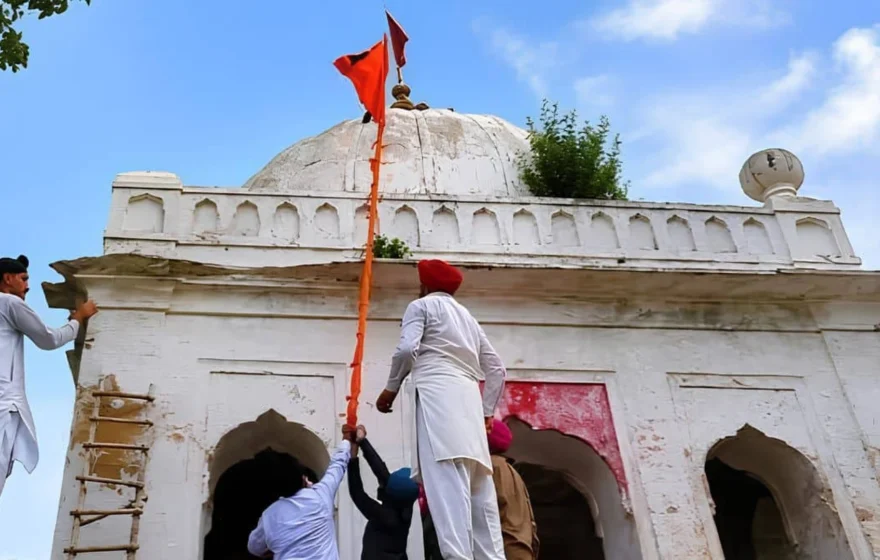
A historic gurdwara in Lahore opened its doors for worship on Sunday, ending a silence of 79 years that began with the Partition of 1947. The Gurdwara Chhevin Patshahi Sri Guru Hargobind Sahib, which stands on Temple Road in Mozang, welcomed members of the Sikh community for the first time in nearly eight decades, after restoration brought the old shrine back to life.
The reopening was marked with a ceremony organised jointly by the Evacuee Trust Property Board (ETPB), the Pakistan Sikh Gurdwara Parbandhak Committee (PSGPC) and the Punjab government. Many Sikhs attended the event, along with senior officials. Punjab Minister for Minorities and PSGPC President Sardar Ramesh Singh Arora, ETPB Secretary Nasir Mushtaq, Deputy Secretary Shrines Usman Khan, Deputy Secretary General Saadat Shehbaz and other officials were present at the ceremony.
Gurdwara Linked to Guru Hargobind Sahib
The shrine is historically associated with Guru Hargobind Sahib, the sixth of the ten gurus of Sikhism. Guru Hargobind, who lived from 1595 to 1644, is remembered as a warrior-saint who strengthened the Sikh community so that it could defend itself against religious oppression.
According to Sikh historical accounts, Guru Hargobind accepted an invitation from the local Sikh congregation and stayed for three days at the home of Bhai Jiwan, a devotee who lived in Mozang, which was then on the outskirts of Lahore. Bhai Jiwan later turned his house into a gurdwara to honour the Guru’s stay, and the shrine grew from that humble beginning.
Shrine Also Associated With Bhai Bidhi Chand
The site also carries a historical link with Bhai Bidhi Chand, who is remembered for recovering two horses named Dilbagh and Gulbagh. According to Sikh accounts, the horses had been seized by the Mughal governor of Lahore, named in different accounts as either Khalil Beg or Qasim Beg, from a devotee who had intended to present them to Guru Hargobind Sahib.
Bhai Bidhi Chand is said to have made two visits to Lahore and to have succeeded in recovering both horses from the royal stables inside Lahore Fort. He is also believed to have stayed at the site of the gurdwara during those visits.
Gurdwara Expanded in 1915
The shrine continued to grow with its congregation in the early twentieth century. The local Sikh congregation expanded the gurdwara hall in 1915, and in 1921 members of the Sangat took control of the shrine’s management after allegations of misconduct against Mahant Hari Singh. They later formed a local management committee to run its affairs.
The old gurdwara building was established in 1926 through the efforts of Sardar Mehar Singh, and the Shiromani Gurdwara Parbandhak Committee (SGPC) took administrative control of the shrine in 1927. The original structure of the gurdwara dates back to the period of Maharaja Ranjit Singh, the Sikh ruler whose capital was Lahore. Regular Sikh worship at the shrine came to an end after the Partition in 1947, when the city’s Sikh population moved across the new border and the building fell silent.
More Than 50 Gurdwaras Under Renovation
Speaking at the reopening ceremony, Sardar Ramesh Singh Arora said restoration work on the historic shrine had been completed and that it was now open to the Sikh community for religious worship. He said more than 50 gurdwaras across Pakistan were currently being renovated as part of efforts to preserve Sikh religious heritage and to provide better facilities for pilgrims who visit the country.
The scale of that work shows how much attention the country’s Sikh heritage is now receiving. Pakistan is home to some of the most sacred sites in Sikhism, including the birthplace of Guru Nanak at Nankana Sahib and the Kartarpur shrine, which pilgrims from India have been able to visit through the Kartarpur Corridor since 2019. Restoring smaller historic shrines such as the one in Mozang extends that care to the neighbourhood gurdwaras where local communities once worshipped.
ETPB Vows to Protect Religious Heritage
ETPB Secretary Nasir Mushtaq said the restoration and reopening of Gurdwara Chhevin Patshahi would give the Sikh community improved facilities for worship while also protecting Lahore’s historical and religious heritage. He said safeguarding places of worship belonging to the Sikh and Hindu communities was one of the ETPB’s major responsibilities, and described the restoration of the gurdwara as an important step in that direction.
Mushtaq also praised the contributions of Giani Balwant Singh and PSGPC committee member Professor Dr Mampal Singh to the restoration work. He said the ETPB’s shrines department would continue its efforts to restore historic gurdwaras and temples across the country, so that places of worship that have stood for centuries are not lost to neglect.
The reopening of a shrine that had been closed since Partition carries a meaning beyond its walls. For the Sikh community, it restores a place of worship tied to the sixth Guru and to the early history of their faith in Lahore. For the city, it returns another piece of its layered past to public life, and for Pakistan it is a visible reminder that protecting minority heritage is shown through open doors and restored buildings, not only through words.
