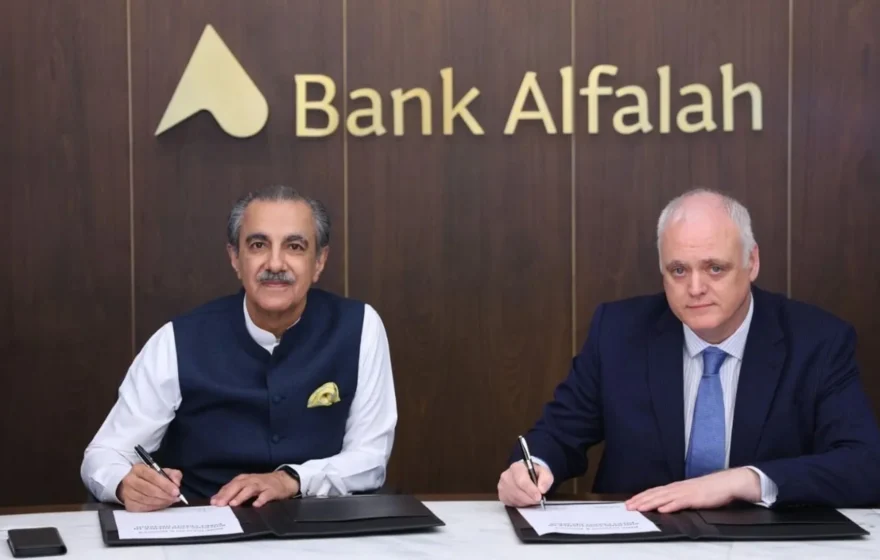
Bank Alfalah has partnered with Moody’s CreditLens as its preferred platform to modernise and strengthen its credit risk rating framework, a move the bank says will sharpen risk assessment, improve governance and bring its practices closer in line with evolving regulatory requirements and global industry standards.
The partnership is built on Moody’s standing as the most suitable solution, judged on its technical capabilities, comprehensive coverage, global acceptance and ability to support stronger governance, auditability and compliance.
Moody’s CreditLens is a credit lifecycle management platform launched in 2017 to digitise commercial credit origination. It brings together data, analytics and workflow automation to streamline how banks assess borrowers, using artificial intelligence and machine learning to automate routine work. It covers the full loan journey, from origination and underwriting through to portfolio monitoring. Its tools include automated financial-statement spreading, which extracts figures from documents and spreadsheets, covenant tracking with automatic warnings when a borrower breaches agreed limits, and measures of probability of default. More than 250 institutions around the world had selected the platform by early 2020.
For Bank Alfalah, the platform’s breadth matters. CreditLens covers Corporate, Commercial, Small and Medium Enterprises, Agriculture, Financial Institutions and Project Finance scorecards, giving the bank a single framework across very different kinds of borrowers. Its access to global and regional datasets can support the development and ongoing refinement of risk rating models across those segments. Through the platform, the bank aims to strengthen the governance and auditability of its risk framework, improve access to relevant data and support more dynamic risk modelling, helping it assess changing credit conditions as they develop.
Atif Bajwa, President and Chief Executive Officer of Bank Alfalah, said strengthening risk management capabilities was essential to building a resilient and forward-looking institution as the banking landscape evolves. He said adopting CreditLens was an important step in modernising the bank’s credit risk rating framework, and that by using advanced modelling and broader data insights the bank aimed to support more informed decisions and keep its risk practices responsive to changing economic conditions and regulatory expectations.
Brendan, Senior Director for the Middle East at Moody’s Analytics, said financial institutions needed robust analytical capabilities and reliable data to support sound credit decisions in an environment where risks were increasingly interconnected and economic conditions continued to evolve. He said CreditLens combined risk expertise, data and technology to help strengthen credit risk assessment and governance, and that Moody’s was pleased to support Bank Alfalah in advancing its risk rating capabilities.
Bank Alfalah is one of Pakistan’s largest private-sector banks. Founded in 1992 and headquartered in Karachi, it is listed on the Pakistan Stock Exchange and sponsored by the Abu Dhabi Group. Its deposits stood at 2.49 trillion rupees at the end of 2025, up 16.8 per cent year on year, with gross advances of 1.15 trillion rupees. Profit after tax was 28.34 billion rupees for 2025, and its capital adequacy ratio of 15.87 per cent sits well above the regulatory minimum. The bank carries a long-term AAA rating from PACRA with a stable outlook, serves more than 9.7 million customers through 1,200 branches in over 245 cities, and in July 2026 raised 20 billion rupees through Pakistan’s largest-ever bank Term Finance Certificate issuance.
The bank has also been investing heavily in digital banking. Its Alfa app had 2.69 million users in 2025, and a rebuilt Alfa 2.0 launched in October 2024. The app supports Raast instant payments, QR payments, Google Wallet and instant loans of up to 750,000 rupees. Digital throughput surged 80 per cent year on year to 9.1 trillion rupees in 2025, and the bank launched Alfa Business, its merchant payment solution, in November 2025.
The timing of the CreditLens adoption is significant, because Pakistan’s banks are working through a wave of regulatory change that demands better risk data and modelling. In September 2025 the State Bank of Pakistan directed banks to begin Phase Two of the Basel Three reforms, focused on revising the risk-weighting regime for credit risk. The revised approach runs on a parallel basis from 30 September 2025 to 30 June 2026, with banks reporting under both old and new rules, and banks must use credit ratings only from State Bank-recognised agencies and apply them consistently. Alongside that, Pakistani banks must apply the forward-looking Expected Credit Loss model under IFRS 9, recognising expected losses from the moment a loan is issued rather than waiting for it to go bad.
This is the regulatory backdrop for a bank adopting a platform like CreditLens. Stronger internal rating and scorecard systems support both Basel capital calculations and IFRS 9 provisioning, and they give a bank a clearer, more consistent view of the risks sitting in its loan book. For a bank of Alfalah’s size, with more than a trillion rupees in advances spread across corporates, small businesses, farms and financial institutions, that consistency is the point. The partnership is therefore less about a single piece of software than about the bank’s ability to keep growing its lending while meeting tougher standards from regulators, rating agencies and its own board, with decisions grounded in better data.
