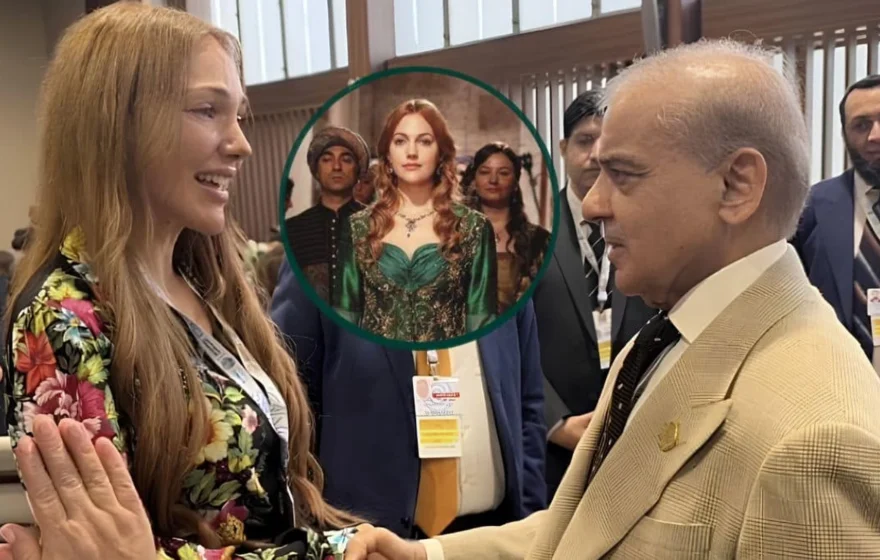
A short handshake on the sidelines of a climate summit in Antalya became one of the most shared Pakistani moments of the week, after German-Turkish actress Meryem Uzerli met Prime Minister Shehbaz Sharif at COP31. Uzerli is the face millions of Pakistanis still know as Hurrem Sultan, the sharp heroine of the Turkish historical drama Mera Sultan, and photographs of the encounter spread across social media within hours.
The meeting took place at the United Nations Climate Change Conference, where world leaders have gathered in the Turkish resort city for twelve days of negotiations. The two shook hands briefly at the summit venue, and the pictures quickly went viral, drawing delighted reactions from Pakistani viewers who grew up watching Uzerli command the Ottoman court on television.
For many in Pakistan, Uzerli is no ordinary foreign celebrity. She is Hurrem, a character who became a household name when Muhtesem Yuzyil, known in English as Magnificent Century, was dubbed into Urdu and aired as Mera Sultan. The series followed a slave girl who rose to become the wife of Sultan Suleiman the Magnificent, and Uzerli’s portrayal of her intelligence, ambition and vulnerability made it appointment viewing across the country.
Born in Kassel, Germany, Uzerli won the role after an eight-month search by the show’s makers, who auditioned widely before settling on the then little-known actress. The gamble paid off. She won the Golden Butterfly Award for Best Actress in 2012, and the series aired in dozens of countries. She left in 2013, citing burnout after three demanding years, and another actress took over as an older Hurrem for the final episodes.
The warmth of the reaction says something about the place Turkish television holds in Pakistan. Dubbed Turkish serials had built loyal audiences here long before streaming, and Mera Sultan was among the most loved. Viewers followed Hurrem’s schemes and heartbreaks night after night, and her name is still recognised instantly more than a decade on.
Uzerli was not at the summit by chance. She attended COP31 alongside several prominent Turkish celebrities, and Turkish First Lady Emine Erdogan greeted her and the other stars at the venue, thanking them for taking part. Their presence added a cultural gloss to a gathering of ministers, negotiators and scientists.
COP31, the 31st meeting of the Conference of the Parties to the United Nations Framework Convention on Climate Change, runs 9 to 20 November at the Antalya Expo Centre. Turkiye holds the presidency, with Minister Murat Kurum as COP president, while Australia leads the formal negotiations. Close to 100 world leaders attended the leaders’ summit on 11 and 12 November, and the conference is billed as a meeting of implementation, where countries must show how they will turn promises into action.
Prime Minister Shehbaz Sharif arrived in Antalya with a clear message. He delivered Pakistan’s National Statement on climate justice, joined clean energy roundtables, and attended a gala dinner hosted by Turkish President Recep Tayyip Erdogan. At the leaders’ summit he pressed the case that climate finance for vulnerable countries should come mainly as grants rather than loans, so nations battered by disasters are not pushed deeper into debt while they rebuild.
Pakistan makes that argument from painful experience. The country produces less than one per cent of global greenhouse gas emissions, yet it ranks among the nations most exposed to climate extremes. The floods of 2022 submerged around a third of the country, affected about 33 million people, killed more than 1,700, and caused damage and losses of more than 30 billion dollars. Reconstruction needs were put at 16.3 billion dollars, and the disaster remains the reference point for every climate argument Pakistan makes.
The pressure has not eased. The monsoon floods of 2025 brought fresh devastation, and Pakistan’s updated climate plan, known as NDC 3.0, commits the country to cutting projected emissions by up to 50 per cent by 2035, a target that depends heavily on international support. Islamabad estimates it needs around 565 billion dollars by 2035 to meet its climate commitments, a figure that explains why his meetings in Antalya kept returning to the question of who pays.
Against that serious backdrop, a handshake with a television star might seem a small thing, yet the reaction shows how culture and diplomacy now travel together. A photograph of the prime minister greeting Hurrem Sultan reached audiences no speech could, in a week when Pakistan was asking the world to notice its climate case. For viewers who shared it, the moment recalled a drama they loved; for the summit, it was a brief, human pause in twelve days of hard negotiation.
The encounter will not change the outcome of COP31, and nobody involved pretended otherwise. But it captured something real: a Pakistani prime minister making his country’s case on a world stage, and a familiar face from a beloved drama standing in the same room. Negotiations grind on until 20 November, and the summit will be judged in finance and emissions, not photographs. Still, in a conference built on getting the world’s attention, this was one moment that needed no translation at all.
