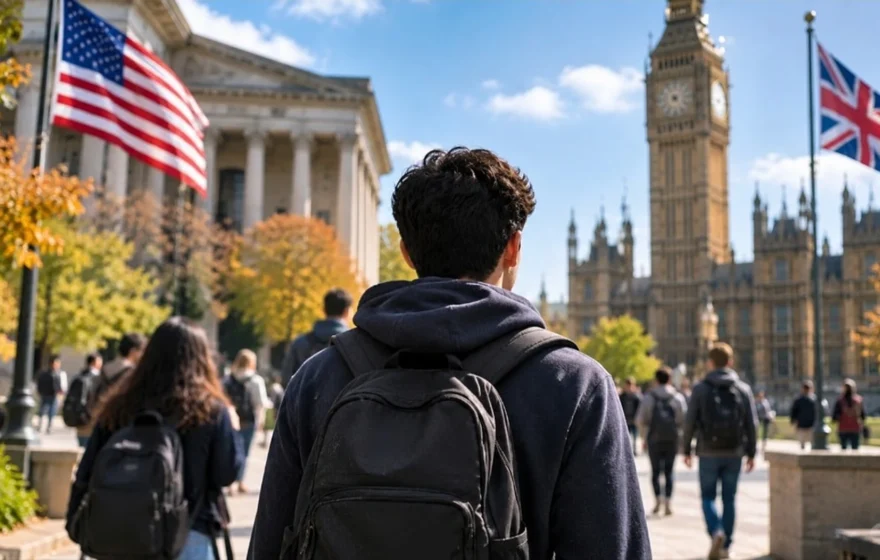
International students are turning away from the United States and Britain and choosing universities in Asia and continental Europe instead, as tighter visa rules and tougher immigration policies redraw the map of global higher education. A wide-ranging survey of hundreds of universities around the world has found that the two countries which once dominated the market for overseas students are now losing them at a striking pace, while institutions elsewhere are picking up the students they turn away.
The survey, carried out jointly by Studyportals, a Netherlands-based student recruitment platform, NAFSA, a United States nonprofit that speaks up for international education, and the Oxford Test of English, run by Oxford University Press, gathered responses from 437 universities across 63 countries. Its findings, published on 12 November, show that international undergraduate enrolments in Britain fell by 19 percent between October and August compared with the same period a year earlier, while the United States recorded a drop of 13 percent. Canada and Australia also reported weaker demand, while universities across Asia and Europe said their international enrolments had grown.
Behind the numbers lies a simple story. The universities that took part named visa restrictions and government policy as the biggest obstacles to recruiting students from abroad. Long waits for visa appointments, tougher screening of applicants, and changes to the rules that let graduates stay on and work after finishing their degrees have left many students postponing their plans or abandoning them altogether. For a young person weighing where to spend years of their life and a large sum of family money, uncertainty over a visa has become a reason to look elsewhere.
In the United States, the shift comes as President Donald Trump tightens immigration measures, including wider checks on applicants’ social media accounts and a series of visa revocations. The message reaching prospective students is that the door which once stood open to the world’s brightest young people is now narrower. American universities were the most downbeat of all those surveyed about what comes next, with more than a third expecting their international enrolments to fall further in the coming years.
Britain has travelled a similar road. The government has restricted most international students from bringing their dependants with them, and it plans to shorten the period graduates are allowed to remain in the country to look for work after their studies. For students from countries such as Pakistan, where many families save for years to send a son or daughter abroad and where the chance to work after graduation is often part of the calculation, those changes strike at the heart of the decision. A degree from a British university still carries weight, but when the rules around it keep changing, the value of the whole package becomes harder to judge.
The consequences reach beyond the lecture hall. International students typically pay far higher fees than students from the home country, and their fees help to pay for teaching and research that benefits everyone at the university. When those students go elsewhere, universities in the United States and Britain lose income they have come to rely on, and the loss is felt in courses, research budgets, and campus life. The students are not disappearing. They are simply choosing different destinations, and the universities that welcome them stand to gain both the fees and the talent.
That is where Asia and continental Europe come in. Universities across those regions have reported stronger international enrolment growth, and many have spent recent years making themselves easier to reach, with more courses taught in English, clearer visa routes, and lower living costs than London or New York. For students from Pakistan and other South Asian countries, destinations closer to home also carry the practical advantage of shorter flights and familiar cultures.
Fanta Aw, the chief executive of NAFSA, said the findings confirmed what many in the sector had already been seeing, that national policies now weigh heavily on where students decide to study, carry out research, and begin their careers. Students do not choose a university on reputation alone. They weigh cost, the visa, the chance of a job afterwards, and whether they will feel welcome. When governments make those calculations harder, no amount of prestige can hold the numbers steady.
The survey was conducted before the midterm elections held in the United States on 3 November, in which the Democrats won control of both chambers of Congress, although the president retains executive authority over visa rules. The results therefore capture the mood under the current administration’s policies rather than any change the election might bring. Whether the new Congress will press for a softer approach remains to be seen.
For now, the picture is one of a market in motion. The United States and Britain, long the first choice for ambitious students from around the world, are watching enrolments slide as visa barriers bite. Asia and Europe are gaining ground, and the students themselves are proving that they will go where they are wanted. Unless the policies change, the shift that this survey has measured is likely to deepen.
