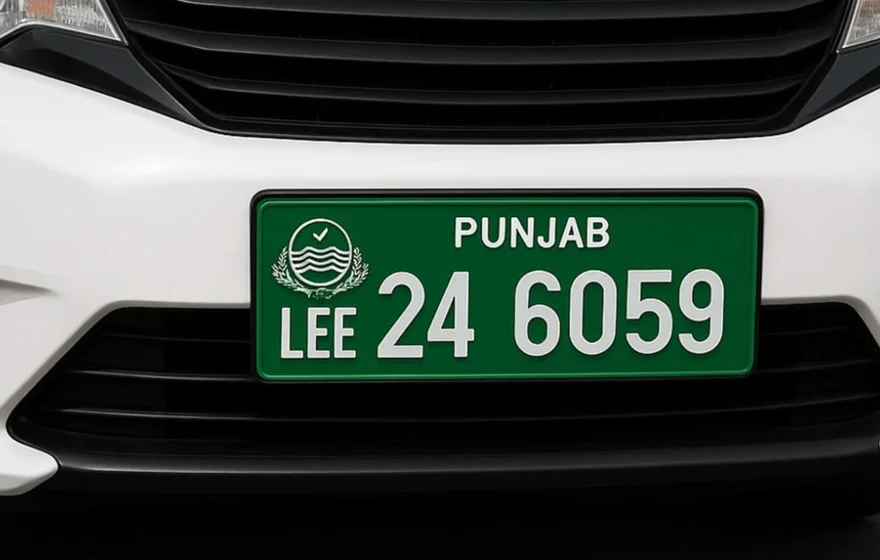
The Punjab Safe Cities Authority has announced a strict crackdown on drivers and motorcyclists who hide or alter their vehicle number plates to escape detection by traffic cameras, warning that no leniency will be shown to anyone caught trying to deceive the system. The authority has released images of cars and motorcycles caught concealing their plates to raise public awareness of a practice it says is spreading on Punjab’s roads.
Safe City cameras have recorded drivers and riders using their hands, cloth, tape and other objects to cover their number plates, in some cases hiding the plate entirely and in others using tape to change a digit or blur a letter.
According to a spokesperson, the authority’s artificial intelligence technology can continue identifying vehicles even when their number plates are hidden. It is continuously monitoring violations and sending alerts to the relevant police departments so legal action can be taken.
The authority emphasised that concealing a number plate is not merely a traffic violation but a deliberate attempt to evade the law, and warned that ignoring such practices could contribute to serious road accidents and the loss of human lives.
Motorists have been urged to follow traffic regulations and to make sure their number plates are properly displayed and clearly visible at all times. The message is aimed at every driver in the province, not only at those already caught on camera.
That system is built around the authority’s camera network, which began in Lahore and now covers Faisalabad, Multan, Rawalpindi, Gujranwala, Sialkot, Bahawalpur, Gujrat and Sheikhupura. Lahore alone has more than 8,000 Safe City cameras running around the clock, using automatic number plate recognition to read a plate and match it against the Excise and Taxation Department’s registration record.
The cameras detect twenty-one violations in total, from running a red signal and speeding to using a mobile phone while driving, not wearing a helmet or a seatbelt, triple riding and driving an unregistered vehicle. When a violation is detected, an automated challan is generated and sent to the registered owner, and the details can be checked on the authority’s portal, echallan.psca.gop.pk, using the plate number and the owner’s identity card or chassis number.
Under the fine schedule revised on December 1, 2025, a first offence for not displaying an approved number plate costs Rs. 2,000 for a motorcycle, Rs. 5,000 for a car below 2000cc, Rs. 10,000 for a larger car and Rs. 15,000 for a public service vehicle, with repeat offences costing far more. The Punjab Motor Vehicle Ordinance 2025 also introduced a penalty points system, with two to four points per violation and suspension of the driving licence once a driver accumulates twenty points.
Unpaid challans do not simply disappear: the Excise and Taxation Department blocks token renewal for vehicles with unpaid fines. Every camera-generated challan also carries photographic evidence, which owners should check, because it shows whether the system genuinely caught their vehicle or misread a plate.
The crackdown is part of a wider tightening of traffic enforcement in Punjab. The authority regards covering a plate as more serious than an ordinary lapse: a driver who jumps a signal can at least be traced and fined, while a driver who hides a plate is trying to make sure that never happens.
There is also a safety dimension beyond fines. Number plates are the basic link between a vehicle and its owner, and they matter most when something goes wrong: a hit-and-run, a stolen vehicle, a car used in a crime, or a crash in which the other driver needs to be found. When plates are hidden, the camera network cannot connect a vehicle to a record, and the roads become harder to police.
The authority has chosen to publicise the images it has collected rather than simply issuing fines quietly. The photographs are a warning, and evidence that the behaviour is common enough to need a public response. Drivers who cover their plates may believe they are outsmarting a camera, but the authority says its artificial intelligence can still identify the vehicle.
For motorists, the advice is straightforward. Plates should be clean, properly fixed, clearly visible and exactly as issued by the Excise and Taxation Department, with no tape, no cloth and no alteration to any letter or digit. A plate that is damaged or faded should be replaced, and any challan on the portal should be checked, disputed through the formal process if it is wrong, and paid if it is right.
The crackdown will be judged not by the images released this week but by what happens on the roads in the weeks that follow. If the number of hidden plates falls, and if the alerts sent to the police lead to real action against repeat offenders, the authority will have shown that its cameras are more than a way of collecting fines. If the practice continues, it will have to answer a harder question: whether a system that depends on a visible plate can cope with drivers determined to keep theirs out of sight.
