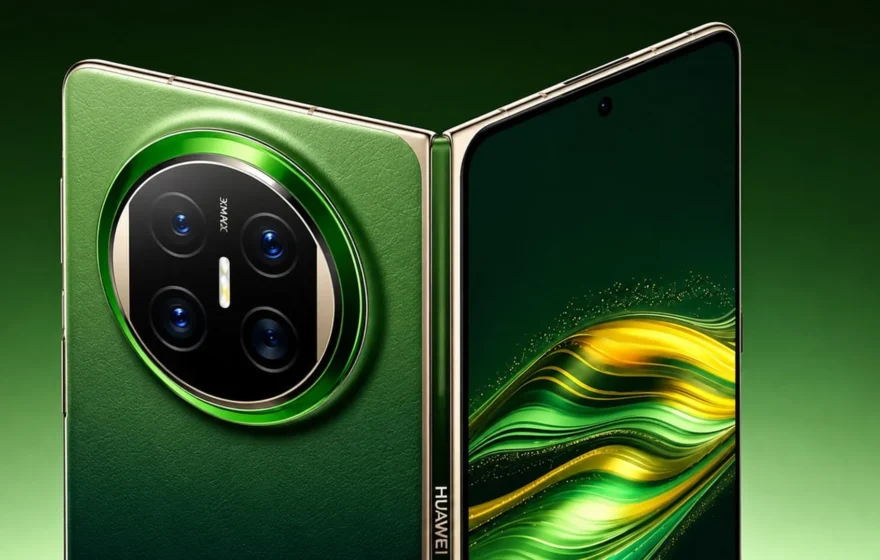
Huawei has turned to magnets to solve the most visible flaw of folding phones. The Mate X8, launched in China on November 24, introduces a magnetic flattening system that the company says makes its inner screen 90 per cent flatter than last year’s Mate X7, with a brighter display, faster chip and bigger battery in a thinner body.
The crease has been the folding phone’s oldest complaint. Since book-style foldables reached the market, buyers have accepted a faint line down the middle of the main screen as the price of carrying a small tablet in a pocket. Makers have spent years narrowing it, yet it has never quite disappeared. Huawei is now betting that magnets can do what hinges alone could not.
The new phone arrives a year after its predecessor. The Mate X7 was launched in China in November 2025, starting at CNY 12,999, with an 8-inch inner display, a Kirin 9030 Pro chip and a 5,525mAh battery. It later reached global markets, and in Pakistan it has been listed at around Rs 491,310. Huawei has answered with improvements in almost every area.
Design and Display
The magnetic system sits at the centre of the design, combining a 0.1mm magnetic composite with steel reinforcement and a micron-level filling process. Huawei says the steel laminate improves bending stiffness by 140 per cent and achieves 99.9 per cent recovery after bending, with the crease as low as 15 microns. In plain terms, the folded area should feel almost level with the rest of the screen.
The displays have grown larger and much brighter. The phone opens to an 8.2-inch OLED display with a 2424 by 2340 resolution, while the 6.54-inch cover screen uses dual-layer OLED with a 2444 by 1132 resolution. Both support adaptive refresh rates from 1 to 120Hz and 1440Hz PWM dimming. Huawei rates the cover display at 12,000 nits at 1 per cent average picture level and 6,000 nits at 20 per cent, against 8,000 and 4,500 nits inside. These are laboratory peaks, so real-world brightness will be lower, but the jump over the Mate X7, rated at 2,500 nits peak, is still striking.
The inner screen gets ultra-thin glass and anti-reflective coating. The phone measures 4.2mm unfolded and 8.95mm folded, slimmer than the Mate X7 at 4.5mm and 9.5mm, and carries IP58 and IP59 ratings. The standard model uses third-generation Kunlun Glass and the Collector’s Edition Xuanwu Kunlun Glass, in five finishes: Purple Gold Brocade, Azure Sky Black, Snowy White, Qingyun Brocade and Danxia Brocade.
Internals and Software
Every version uses the Kirin 9050 Pro processor and HarmonyOS 7.0, combining a nine-core, 16-thread Linxi CPU, a Maleoon GPU with second-generation hardware ray tracing, and a Da Vinci NPU. Huawei claims 31 per cent higher overall performance than the Mate X7, but these are manufacturer figures, and independent tests will be needed.
Standard models offer 12GB of RAM with 256GB or 512GB of storage; Collector’s editions provide 16GB with 512GB, 1TB or 2TB. Huawei also says combining cellular and Wi-Fi antennas increases antenna area threefold and improves signal strength by 2dB, a useful gain for a phone whose metal and glass body leaves little room for aerials.
Cameras
The built-in system combines a 50-megapixel main camera, a 40-megapixel ultrawide and a 50-megapixel periscope camera, alongside Red Maple colour sensing, with the main sensor differing between the standard and Collector’s editions. All versions also support the optional Ruiying Z10 module, which adds a one-inch 50-megapixel RYYB sensor, optical stabilisation and 10x continuous optical zoom, though a software update and a dedicated case are needed.
Battery and Pricing
The phone has a 6,200mAh battery with 66W wired and 50W wireless charging, plus reverse wireless. That is a clear step up from the 5,525mAh cell in the Mate X7, and it matters because a folding phone must power two large, bright screens.
Approximate Chinese prices start at $1,950 for 12GB and 256GB and $2,100 for 12GB and 512GB, while Collector’s editions cost around $2,400 for 16GB and 512GB, $2,550 for 16GB and 1TB and $3,150 for 16GB and 2TB. Presales began on November 24, and the first four configurations go on sale on December 4 at 10:08 a.m. China time, or 07:08 PKT, while the 2TB model follows on December 20 in Purple Gold Brocade and Azure Sky Black. Launch offers include up to 12 interest-free instalments and a trade-in subsidy of about $120, and international availability, including Pakistan, remains unconfirmed.
The Mate X8 is Huawei’s answer to the one question every foldable buyer asks: will the screen still look new a year from now? The magnetic system, tougher glass and brighter panels all point in the same direction, while the larger battery and faster chip remove two of the usual compromises. The price is the catch: it starts above the Mate X7’s Chinese launch price, and with the older phone listed in Pakistan at around Rs 491,310, a local launch would almost certainly push past Rs 500,000. Whether the crease really has been tamed will only become clear once the first buyers start folding it daily, away from Huawei’s laboratory.
