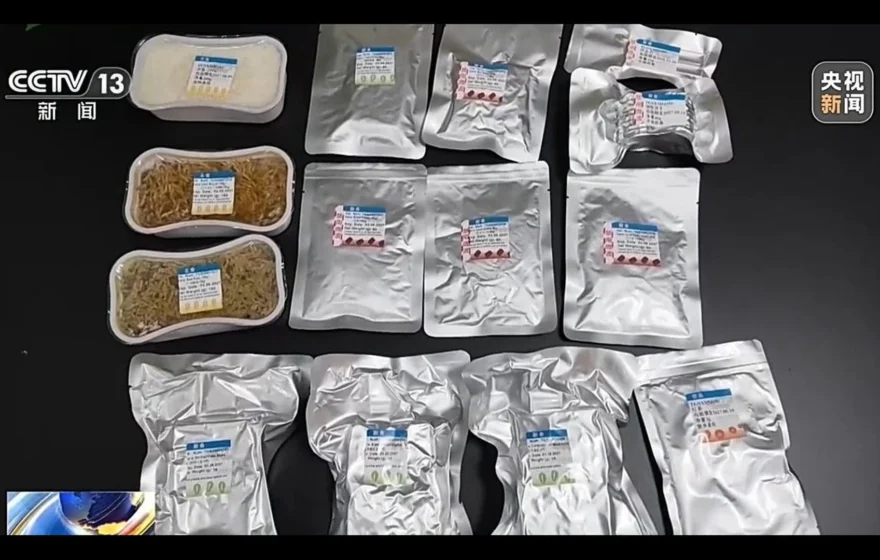
Pakistan’s first astronaut will sit down to butter chicken, beef nihari, lamb korma and curried chickpeas above the Earth. Muhammad Zeeshan Ali, who arrived at China’s Tiangong space station on Wednesday aboard the Shenzhou-24 spacecraft, has a dedicated halal menu waiting for him, with more than 100 varieties prepared for his stay in orbit.
The meals were put together by the China Astronaut Research and Training Center, which studied Pakistani food culture, halal requirements and nutrition standards, then adapted dishes from China’s existing space food library, according to a CCTV News report carried by China Daily.
The food is one small, human detail of a mission that has made history. Ali lifted off from Jiuquan Satellite Launch Centre in north-west China on Wednesday morning aboard a Long March-2F rocket, with commander Tang Hongbo and flight engineer Wu Yi. It docked with Tiangong about three and a half hours later, making Ali the first Pakistani to reach orbit and the first foreign astronaut to board the Chinese station. He will spend around a week there as a payload specialist before returning to Earth aboard Shenzhou-23.
Ali is a 40-year-old Pakistan Air Force pilot. He was chosen under a February 2025 agreement between Pakistan and China to select and train Pakistani astronauts for missions to Tiangong. He and fellow pilot Khurram Daud came through three rounds of screening and were picked in April to train in China. Ali won the seat on Shenzhou-24, with Daud as his backup. Before the flight he told reporters: “I’m not flying for myself. I carry the name of Pakistan on my shoulder.”
He trained in Beijing for about seven months, including intensive Chinese-language classes. His work in orbit is scientific: he will run experiments in the station’s Wentian and Mengtian laboratories, including growing microalgae as a possible food and oxygen source and testing how spaceflight affects quinoa seeds. The work builds on four Pakistani biotechnology experiments chosen from more than 300 proposals, focused on food security and climate change.
Seven Pakistani-Style Space Foods
The centre in Beijing developed seven Pakistani-style space foods for the mission. Four are named: beef nihari, lamb korma, butter chicken and curried chickpeas. Chen Junli, a researcher at the centre, said the recipes were designed to meet energy and nutrition standards, with lighter food at the start of the mission and room for the spices Ali is used to, such as turmeric and curry. The entire production line was halal. The meals were taste-tested repeatedly and the recipes refined, with positive feedback.
The attention to food is not decoration. A familiar meal does more than provide calories: for a crew member who trained for seven months in another language and food culture, a plate of nihari is a small piece of Pakistan carried into orbit.
Chinese Rice and Tea, at His Request
The menu was not fixed in advance and left untouched. The original plan included Pakistani spiced milk tea, but after arriving in China Ali found he liked Chinese black tea and Chinese rice, and asked for more of both to be packed for the flight. They were added to the menu. It is a small exchange, but it captures the mission: a Pakistani astronaut eating Chinese rice, and Chinese researchers cooking nihari.
The six astronauts now aboard Tiangong will also share a special dinner while their missions overlap. Chen said that meal is built around dishes both crews enjoy; at other times the astronauts choose how they eat. Ali will return to Earth with the Shenzhou-23 crew.
A Familiar Idea
Pakistan is not the first country to send its food into orbit. In October 2007, Malaysia’s Sheikh Muszaphar Shukor flew to the International Space Station carrying vacuum-packed Malaysian dishes, including chicken satay and ginger jelly, and celebrated Eid al-Fitr in orbit. What is new here, Chen said, is that this is the first time China has put together a full nutrition plan for an astronaut from a different food culture, covering research, ingredients, recipes and how meals are eaten in orbit.
More Than a Meal
In Islamabad the mission has been greeted as a national milestone, and Prime Minister Shehbaz Sharif said Pakistan had begun its journey “beyond the stars”, noting it would become the first country after China to travel to Tiangong.
One distinction is worth making. Ali is the first Pakistani to reach orbit and the first formally trained Pakistani astronaut on an orbital mission. Namira Salim, a Monaco-based adventurer, became the first Pakistani citizen to reach the edge of space in October 2023, on Virgin Galactic’s Galactic 04, a suborbital flight. Ali’s journey is different in kind: a state-selected pilot on a government mission.
For SUPARCO, Pakistan’s space agency, the week in orbit is a beginning rather than an end. The experiments Ali runs and the data he records will shape whatever comes next for a country that has waited decades to put one of its own into orbit. The menu, prepared dish by dish in Beijing, is part of that story: a mission planned down to the last detail, including what its astronaut eats for dinner.
