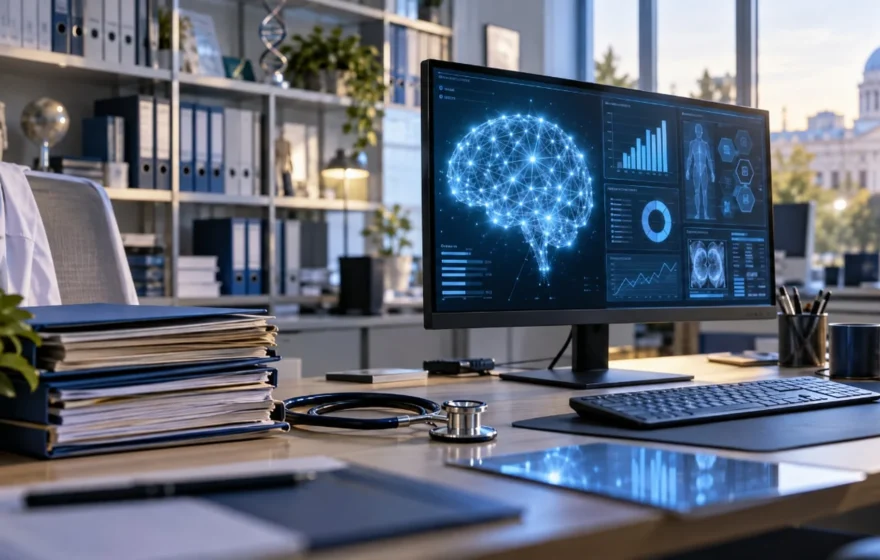
The University of Health Sciences in Lahore is looking to artificial intelligence to modernise one of the largest medical education systems in the country, from the admissions process that decides who becomes a doctor to the filing cabinets that hold decades of student records. The university is exploring AI-based solutions for its administrative and academic operations, with a particular focus on admissions, human resource management, digital record-keeping, data management and overall institutional efficiency.
The move was discussed during a meeting between the university’s vice chancellor, Professor Sohail Sabir, and a delegation from Neudym, a technology company associated with the Pakistan Army that specialises in artificial intelligence and other emerging technologies. The delegation was led by Colonel Dr Yasir Awais Butt.
What AI Would Do at UHS
Neudym presented a range of AI-powered solutions during the meeting, arguing that the technology could automate routine processes and improve access to institutional information. The proposed collaboration covers an AI-enabled admissions and recruitment framework, automated human resource management, the digitisation and intelligent archiving of university records, and an institutional knowledge management system.
For a university of UHS’s size, those are not abstract ambitions. Every year the university manages admissions for medical and dental colleges across Punjab, processing applications from tens of thousands of students and compiling merit lists. The first MBBS selection lists for Punjab’s public and private medical colleges were issued only recently, and the process is watched closely by students and parents who know that a single error can cost a candidate a seat. An AI system that could check documents, flag inconsistencies and answer routine queries would take real pressure off the staff who run that process, provided it is accurate and transparent.
The same logic applies to the university’s own workforce. Human resource management in a large public institution means tracking appointments, promotions, leave and service records for hundreds of employees, much of it still on paper or in disconnected spreadsheets. Automating those routines would free administrators for work that actually needs human judgement.
Perhaps the most consequential part of the proposal is the plan to digitise and intelligently archive the university’s records. Universities accumulate enormous paper trails: examination results, affiliation files, inspection reports and correspondence stretching back decades. When those records sit in filing cabinets, finding a single document can take days. A searchable digital archive, combined with a knowledge management system that lets authorised officers retrieve information through simple queries, would change how the institution remembers its own decisions.
Keeping Data On-Campus
Neudym also demonstrated capabilities in academic analytics, research management and document processing. But the part of the presentation likely to matter most was the proposal for a private AI infrastructure running on the university’s own servers, so that institutional data stays within its own digital environment.
A medical university holds deeply sensitive information: student records, examination data and staff files. Sending that data to outside servers would raise obvious questions about privacy, security and control. By keeping the AI systems on campus, UHS would retain custody of its own data while still gaining the benefits of automation. It is a model that other public institutions in Pakistan, wary of data leaving the country, are likely to watch closely.
That emphasis reflects a wider unease about artificial intelligence in public life. A system that decides, or helps to decide, who gets a medical seat or a promotion must be fair, explainable and open to challenge. If students or staff come to believe that an algorithm is making decisions they cannot question, the technology will create more problems than it solves. UHS will need to show, from the start, that humans remain in charge of the decisions that matter.
Pilots First, Then Expansion
Professor Sabir emphasised the need to harness emerging technology to improve governance, transparency, efficiency and service delivery, noting that AI could transform conventional systems into integrated, intelligent and data-driven processes. Both sides explored introducing selected AI solutions through pilot projects, followed by evaluation and potential expansion.
That cautious approach is the right one. A pilot allows the university to test a system on a limited scale and measure whether it genuinely saves time. Admissions, with its hard deadlines and high stakes, is a demanding place to start, but it is also where the benefits would be most visible. If a pilot can show that applications are processed faster and errors are caught earlier, the case for expanding the system will make itself.
The AI proposal builds on work already under way at UHS, which has been moving its processes online with a dedicated admissions portal and published merit lists.
There is a broader significance too. If one of Punjab’s largest public universities can show that AI improves administration without compromising fairness or privacy, other universities and public bodies will follow. The meeting with Neudym was only a discussion, not a signed deal, and the pilots have yet to begin. But the direction is set: the university that decides who becomes a doctor in Punjab now wants machines to help it do the paperwork, so that its people can focus on the teaching, the research and the students.
