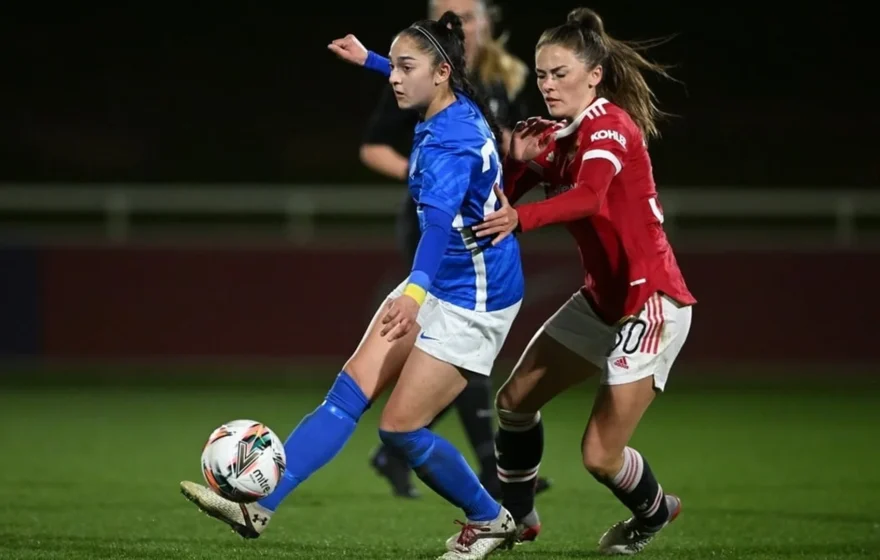
Pakistani footballer Layla Banaras has won the Female Elite Sports Athlete of the Year award at the Muslim Sports Awards 2026. The 20-year-old plays her club football for Lewes in England and represents Pakistan at international level. She has now collected two awards in the space of a few weeks, and each one underlines how quickly she has become one of the most recognisable faces of the women’s game in Pakistan.
The Muslim Sports Awards honour Muslim athletes across a wide range of sports, and the elite athlete prize is among the evening’s most prominent awards. For Banaras, the recognition comes at the end of a season in which she has broken new ground for Pakistan on the pitch and spoken openly about identity, faith and belonging off it. It rewards more than results alone.
Only last month, Banaras was honoured at the Asian Football Awards in London, where she won the Women’s Young Player award. The ceremony took place at Syon Park on 29 September, in the sixth edition of awards celebrating British Asians in football. Her Pakistan teammate Mariam Mahmood was also recognised, winning the Women’s Player award. The event is supported by the Football Association, the Professional Footballers’ Association and the Premier League.
Banaras was born in Birmingham in 2006 to a Pakistani father and an English mother. Her football story began in grassroots football with Solihull Moors before she joined Birmingham City at the age of eight. She came through the club’s academy, and in 2023 she became the first woman of South Asian heritage to represent Birmingham City in the club’s professional era. She was only 16 at the time, coming on as a substitute in an FA Cup tie against Huddersfield Town, a match Birmingham won 4-0.
After Birmingham, she spent a spell with Wolverhampton Wanderers before joining Lewes in August 2025. Lewes play in the FA Women’s National League South, and the move gave her regular football in a competitive league at a club known for its community work and commitment to equality. She has become a regular in the side since arriving.
Her decision to represent Pakistan was years in the making. She was first approached about playing for the country of her father’s birth when she was 13 or 14, but she felt too young and put the idea to one side. When the 2026 AFC Women’s Asian Cup qualifiers came around earlier this year, she decided the moment had arrived. The process involved a passport application, a NICOP card and paperwork from relatives, but it came together quickly and she found herself on a plane to Jakarta with the national squad. Mahmood went through the same process at the same time.
The qualifiers proved to be the perfect introduction. Banaras made her first tournament appearance in Pakistan’s 2-0 win over Indonesia, setting up a goal for Nadia Khan, and in her next match she assisted both of Mariam Mahmood’s goals in a 2-1 victory over Kyrgyzstan. Those performances announced her as a player of real quality and showed that Pakistan’s decision to look to the diaspora for talent could pay off.
The biggest stage of her young international career arrived in April, when Pakistan took part in the FIFA Series in Abidjan, Ivory Coast. It was the first time Pakistan had ever featured in a FIFA-organised event at any level. On 9 April, Pakistan beat the Turks and Caicos Islands 8-0, the biggest win in the country’s international football history, surpassing the 7-0 victory over the Maldives in 2022. Banaras scored twice, in the 31st and 79th minutes. The tournament then brought a sterner test, with a 1-0 defeat to Mauritania and a 2-0 loss to the hosts, but the opening result made the trip a landmark. Pakistan’s FIFA ranking rose from 157th to 154th, and the team crossed the symbolic mark of 1,000 ranking points.
What sets Banaras apart is the work she has done away from the pitch. At 15, she noticed there was almost no tailored guidance for Muslim athletes who train and play while fasting during Ramadan, so she worked with Birmingham City’s nutritionist Isobel Cotham and the Professional Footballers’ Association to develop a Ramadan nutrition guide and meal planner. She expanded the project in 2025 into a full guide and planner. She has also become an ambassador for Brown Girl Sport, a platform giving British South Asian women a safe space to share their experiences in sport.
For Pakistan women’s football, the award is another sign of how far the team has come, but it also highlights the challenge ahead. The national team has not played a match since the FIFA Series in April, and the momentum built in Jakarta and Abidjan will fade quickly without regular fixtures and proper planning. Banaras and her teammates have shown what is possible when the team is given a platform, and the recognition she is now receiving in England is a reminder of the talent available to Pakistan. The next step is to make sure that talent has matches to play and a structure to grow in.
