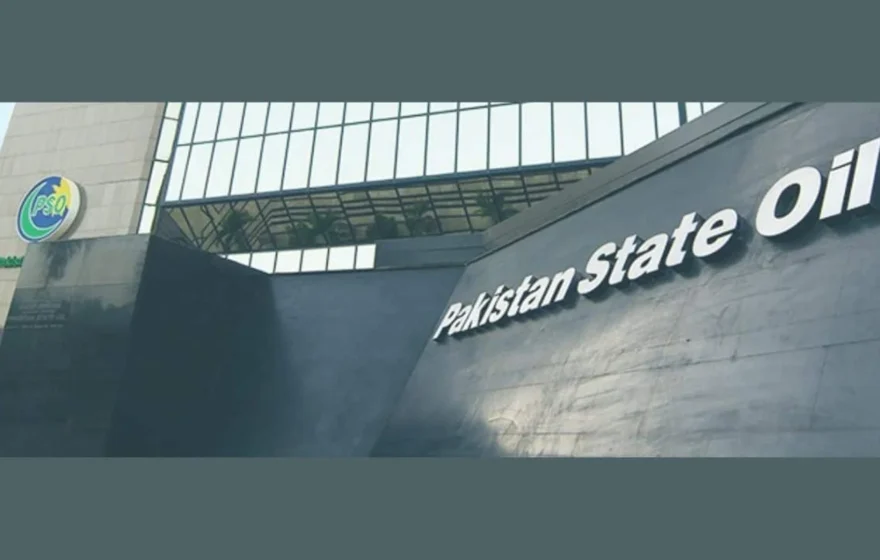
Pakistan State Oil Company Limited, the country’s largest fuel retailer, grew its petroleum sales by 17.8 per cent in the first quarter of the 2027 financial year, more than double the industry’s growth of 7.1 per cent, and lifted its overall market share by 4.2 percentage points to 45.9 per cent. The result, covering a quarter marked by geopolitical tension, disrupted regional shipping and volatile international oil prices, shows a company not only selling more fuel but selling it while keeping supplies flowing to every part of the country.
That continuity of supply is central to the story. PSO kept fuel moving to transport, agriculture, industry, aviation and power users at a time when regional supply routes were under pressure, and a failure would have been felt far beyond its own balance sheet.
The financial results were striking. PSO recorded a profit after tax of 25.56 billion rupees for the quarter, translating into earnings per share of 54.44 rupees, compared with 9.39 billion rupees and 20.00 rupees per share in the same period last year. The company attributed the performance to higher sales volumes and an improved product mix, partly offset by higher finance costs. At the consolidated level, including the contribution of Pakistan Refinery Limited, the group’s profit after tax stood at 29.42 billion rupees, with earnings per share of 62.66 rupees. The scale of the improvement underlines how sharply the company’s fortunes have turned compared with a year earlier.
Asif Baigmohamed, chairman of PSO’s Board of Management, congratulated the board, management, employees and shareholders, describing it as a distinct honour for the board to have presided over a period in which profitability had risen by several hundred per cent. He said the achievement reflected the collective commitment and steadfast confidence of all stakeholders. His remarks pointed to a board tenure defined by this turnaround, and to a result that the company’s leadership clearly regards as a collective effort rather than the work of any single part of the business.
Chief Executive Jawwad Ahmed Cheema struck a similar note, saying the company had grown at more than twice the pace of the market while keeping fuel available across Pakistan through one of the most disrupted periods for regional supply in recent years. He said the gains in market share reflected the trust customers place in PSO and the dedication of its people, who delivered the results safely. He added that the company is strengthening its supply chain by broadening its sourcing options, making greater use of domestic refinery supplies and building resilience against external shocks. For PSO, he said, securing energy for Pakistan is more than a commercial responsibility; it is a national duty, and the company’s commitment remains keeping Pakistan moving today while building a more secure, resilient and sustainable energy future.
Growth was spread across the key product segments. Motor gasoline sales rose 23.2 per cent to 968,000 metric tonnes, while high-speed diesel sales grew 12.8 per cent to 759,000 metric tonnes, even as national diesel demand contracted. PSO thus gained diesel ground in a shrinking market, not an expanding one. Aviation fuel sales increased 15.5 per cent, with PSO supplying 99.6 per cent of the Jet A-1 market, a near-total dominance of the fuel that keeps the country’s aircraft flying. Lubricant sales grew 17.4 per cent to 9,970 metric tonnes, completing a picture of growth in every major line.
Behind those sales lay a considerable supply operation. Amid pressure on regional routes, PSO imported 16 cargoes of petroleum products totalling 756,000 metric tonnes and lifted 1.019 million metric tonnes of motor gasoline and high-speed diesel from local refineries. By coordinating imports with domestic supplies and keeping its sourcing options open, the company maintained nationwide availability. It also managed Pakistan’s long-term liquefied natural gas supply portfolio during a period when a supplier declared force majeure, working with the government to protect supplies to the power and gas sectors. After the quarter ended, PSO signed a government-to-government sale and purchase agreement with Oman’s OQ Trading, widening Pakistan’s fuel sourcing options and adding another layer of resilience to the supply chain.
Safety was another feature of the quarter: zero fatalities, zero lost-time injuries and zero recordable incidents across its owned and controlled locations, a meaningful achievement in an industry where handling, transport and storage carry constant risk.
The company also added 37 retail sites, taking its network to 3,727 outlets, the largest in Pakistan, and extended its electric vehicle charging network to 16 locations. Through PSO Renewable Energy and progress on the Pakistan Refinery Limited expansion project, it is positioning itself for a future beyond traditional fuels, though that diversification is still at an early stage.
Beyond its operations, the PSO CSR Trust contributed 112 million rupees to education, healthcare and community development across Pakistan. Looking ahead, PSO says it will strengthen energy security by diversifying supply sources, reinforcing its supply chain and investing in infrastructure and emerging energy solutions. The first quarter’s results suggest that, for now, that ambition is backed by numbers moving firmly in its favour.
