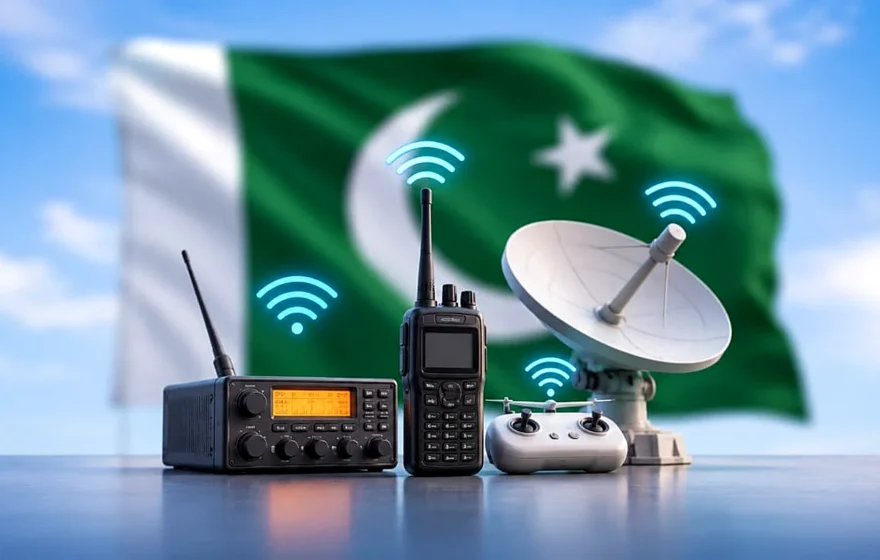
Radio communication, radar, tracking devices and other wireless equipment used in Pakistan will now have to meet mandatory technical standards. Manufacturers and importers must ensure their products meet government-approved requirements before they can be supplied, in a move that brings greater regulatory oversight to equipment used in communication systems, including aviation and emergency services.
The aim is straightforward, even if the technology is not. Wireless devices share the same invisible resource, the radio spectrum, and equipment that does not meet agreed standards can interfere with other services, perform unreliably, or fail at a critical moment. By setting mandatory standards and giving authorities more power to check compliance, the rules are intended to protect the systems that ordinary people and essential services depend on every day.
Which Devices Are Covered?
The requirements have been introduced by the Ministry of Information Technology and Telecommunication through the Telecommunication Equipment Standards Regulations, 2024. The scope is deliberately broad, covering several kinds of equipment rather than a single product type. It includes very high frequency and ultra high frequency radio devices, radar systems that detect objects and track their movement, devices used for tracking and tracing, amateur radio and auxiliary radio equipment, and ground and airborne model control equipment.
The regulations also cover other wireless communication devices and terrestrial telecommunication equipment, and they specify technical requirements for radar systems operating across different frequency bands. That breadth matters, because wireless technology is no longer confined to a single industry. It appears in transport, security, emergency response, hobbyist equipment, industrial monitoring and everyday communication, and a standard that covered only one corner of that world would leave important gaps.
Importers Must Meet New Requirements
Under the regulations, manufacturers and importers must ensure their equipment meets the prescribed technical standards before it reaches users. That responsibility is not left to a general promise. Those applying for a Certificate of Conformity must submit documents to prove that their equipment meets the requirements, so that compliance can be checked rather than simply claimed.
The supporting evidence includes declarations confirming compliance with the standards, test reports from accredited laboratories, bills of lading or air waybills, technical documents and product information, and any other documents required by the Authority. Taken together, those materials are meant to create a clear trail from the factory or the port of entry to the product itself, showing what the equipment is, where it came from, and how it was tested.
For businesses, that trail brings both a discipline and a cost. Companies that already test their products and keep proper records should be able to adapt, although they will need to make sure their documentation matches the Authority’s expectations. Companies that have relied on informal practices, or that have treated testing as an afterthought, will face a more significant adjustment. In the longer term, however, a consistent standard can also help reputable suppliers, by making it harder for non-compliant products to undercut them on price.
Inspection Without Notice
The regulations also give authorised government officers the power to inspect or survey telecommunication equipment to check whether it meets the required standards, and those inspections can take place with or without prior notice. That element is important, because a system that only checks paperwork at the point of application can miss problems that arise later, whether through changes in manufacturing, poor storage, or equipment that has been modified after approval.
Importers, manufacturers and licence holders must also maintain updated records of their equipment for at least three years, and they must provide those records to the Authority whenever requested. The three-year requirement means that compliance is not a one-off event. A company needs to be able to show, well after a product has been supplied, what it supplied, when, and on what basis it claimed conformity.
For consumers, the immediate effect may be invisible, and that is arguably the point. A radio that works cleanly, a tracking device that reports accurately, and radar that can be trusted are all easier to take for granted when standards are enforced. The new framework does not promise that every device will be perfect, but it does create a clearer chain of responsibility, from manufacturer and importer to regulator, and a stronger basis for acting when equipment falls short. As wireless technology becomes more central to daily life, that kind of oversight is likely to matter more, not less.
The spectrum point is worth stressing, because interference is not an abstract risk. A poorly made transmitter can crowd out neighbouring frequencies, degrade a legitimate service, or create confusion in safety-critical settings. Standards therefore do more than protect buyers from poor products. They protect the shared environment in which all wireless equipment must operate, and they give regulators a common language for judging whether a device belongs in that environment at all.
