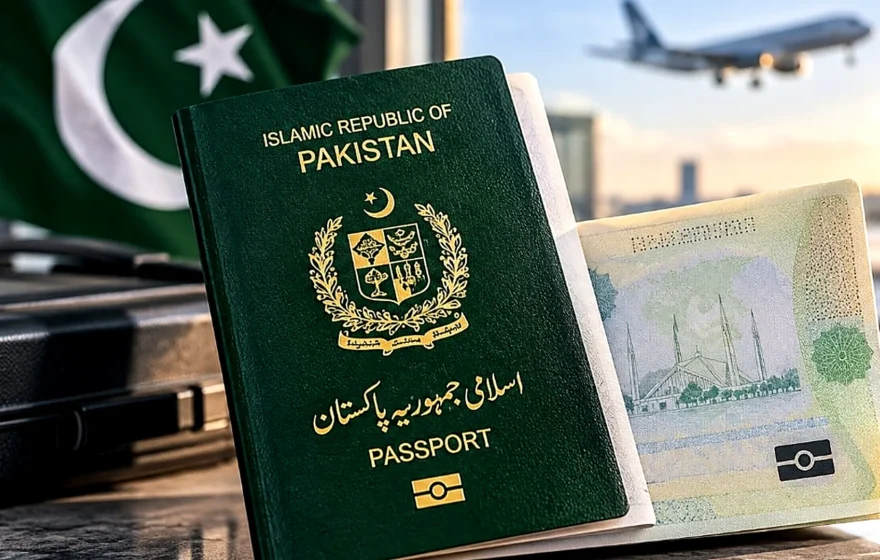
Pakistan is moving towards making the security chips used in its electronic passports at home, to strengthen the document’s security and reduce reliance on foreign suppliers. The plan was discussed at a virtual meeting chaired by the Director General of Immigration and Passports, where officials of the Pakistan Security Printing Corporation reviewed the whole passport production chain, from printing and supply to the availability of booklets for applicants, and agreed to begin work on local chip development.
At the heart of the discussion was the chip itself. In a modern e-passport, the chip stores the holder’s photograph and personal details in digital form, together with a digital signature from the issuing authority. When the passport is presented at a border, a reader can check that signature and confirm that the data has not been altered since the document was issued. That check is what makes the chip harder to forge than a printed page alone. The chip is read without contact, using the same kind of near-field technology found in contactless cards, and its format follows the International Civil Aviation Organization’s Doc 9303 standard, so a compliant passport issued in one country can be verified by compliant systems in another.
Officials also discussed strengthening the security features of Pakistan’s e-passports more broadly, bringing existing standards fully into line with international requirements, and improving the production of polycarbonate data cards. The data page of an e-passport is commonly made from polycarbonate, a tough plastic layer into which the holder’s details can be laser-engraved rather than simply printed on paper. Laser engraving is difficult to alter without visible damage, and the material resists bending, moisture and everyday wear far better than a paper page. The printed and electronic records must agree. The Director General directed officials of the Pakistan Security Printing Corporation to work with a team from the National University of Sciences and Technology on developing the chips locally and ensuring their security, pairing the corporation’s secure production experience with a university team’s research capacity in electronics and information security.
Officials stressed that the plan fits the government’s wider vision of digital transformation and greater reliance on local technological capability. That framing is important, because local production of a security chip is not only a technical project. It is also a question of control. When a country imports the chip at the centre of its passport, it depends on outside suppliers for price, delivery and continued support, and it must trust that the component has been made to specification. Building that capability at home, if it is done to the required standard, gives the issuing authority closer oversight of the whole document, shortens the supply chain for a critical component and builds domestic expertise that can be applied to other secure documents as well. The trade-off is equally clear: a locally made chip will only be useful if border systems abroad accept it without hesitation, so it must pass the same interoperability and security tests as any imported chip.
The timing matters because the chip is now at the centre of Pakistan’s passport system. The country introduced chip-based biometric passports in 2022, and the e-passport has since become the standard document for new applicants, with the older machine-readable passport being phased out for new applications from October 2026. That shift means demand for chips will track demand for passports themselves, and a production system that depends entirely on imported chips has to absorb every delay, price change and supply disruption in that market. Local production is meant to give the passport system a more predictable base, provided the quality and security of the domestic chip can be demonstrated. The printing corporation itself has also been reshaped recently, with the state company that handled passports merged into it with effect from July 2025.
For ordinary passport holders, the immediate effect of the announcement is limited, and it is worth being plain about what has not yet been decided. The report of the meeting did not set out a timetable for when locally made chips would be ready, how many would be produced, what they would cost, or when they would first appear in issued passports. Those questions will only be answered as the work with the university team progresses and as prototypes are tested against international standards, and there is no suggestion in the report that existing e-passports, or the chips already in them, are in any way unsafe. The plan is about where future chips come from, not about the validity of documents already in circulation. What happens next will be the real test. The printing corporation and the university team will need to show that a locally developed chip can store and protect biometric and personal data, carry a valid digital signature, work reliably with readers and e-gates abroad, and survive the physical life of a passport booklet. If that testing succeeds, Pakistan will have taken a genuine step towards self-reliance in a sensitive technology. If it stalls, the meeting will remain what it is for now, a decision to begin.
