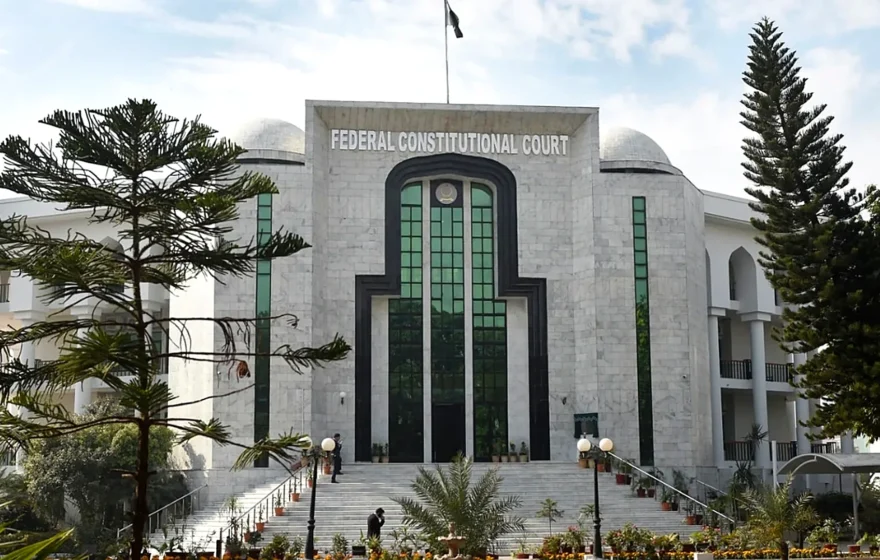
Pakistan’s Federal Constitutional Court has ruled that the registration of a First Information Report, on its own, cannot disqualify a person from government employment. Departments must stop treating an FIR as if it were a conviction, the court said, and must judge candidates on verified facts, on merit, and in accordance with the law.
The ruling came from a two-member bench headed by Chief Justice Aminuddin Khan, with Justice Ali Baqar Najafi also sitting. It was given in an appeal filed by Abdul Latif, who had been kept out of a job in the Punjab Police even though a court had already acquitted him. The bench set aside an earlier Lahore High Court decision and the departmental decision that excluded him, and it restored his candidature.
Latif had stood second on the merit list for the post of driver constable in the Punjab Police Department. Despite that ranking, and despite an acquittal in October 2018, his appointment was refused because of his earlier involvement in a criminal case. Police character certificates issued afterwards recorded that he had no criminal record, yet the Multan bench of the Lahore High Court rejected his plea in May 2025. That judgement has now been overturned.
At the centre of the ruling is a distinction the court says must never be blurred. An FIR is simply the first account given to the police that an offence may have been committed. It begins an investigation; it does not decide guilt. A person named in an FIR may have no case to answer, the investigation may find nothing against him, or a court may acquit him after trial. To treat that starting point as a final verdict would replace a judicial decision with administrative suspicion, offending the principles of legality, fairness and equal treatment.
That reasoning changes how character verification must be carried out. The court directed federal and provincial authorities, and law enforcement agencies in particular, to adopt uniform, transparent and constitutionally sound rules for checking candidates’ past records. Where a candidate has been acquitted, that acquittal must be given its proper weight, and a police character certificate should not keep showing a case against him in a damaging way after the courts have cleared him. Where proceedings are still pending, the certificate may record only that they are pending; it must not present the allegation as though the offence had already been proved.
The court also dealt with people already in service. No one should be removed from service, it held, without being heard and without a decision reached on the arguments and material before the authority. Recruitment decisions must follow legal standards, respect merit and meet the requirements of justice.
These directions are linked to the rules governing police recruitment. The Police Rules of 1934 deal with appointment and the verification of antecedents, and one provision, Rule 12.18, has often been central to disputes about past criminal involvement. The court held that this rule must be read together with the wider statutory scheme and constitutional principles, not stretched into a permanent bar that was never created by law. Involvement in a case that ended in acquittal before recruitment began cannot, without other independently established adverse material, amount to a lifelong disqualification.
For job seekers, the ruling matters because an FIR is not a rare event in Pakistan. Disputes over land, family matters, neighbourhood quarrels and business dealings can all end up at a police station, and not every report leads to a strong case. If every FIR became a permanent stain, many able candidates would be excluded for reasons unrelated to their ability, honesty or fitness for the job. The court has now said that such an approach is unfair to the individual and harmful to the public service, because it narrows the field on an irrelevant ground.
For departments, the ruling does not remove the duty to check candidates properly. It changes how the check must be done. An adverse finding must rest on authentic material that can be independently verified, rather than on conjecture, rumour or suspicion. That means examining court orders and investigation outcomes, and weighing them objectively, under policies applied consistently across offices.
There are limits that protect both sides, and they are worth stating plainly. The court has not said that a candidate’s past can never be considered. An acquittal must be recognised, subject to an objective assessment of antecedents and suitability, and adverse material which genuinely exists and can be verified may still be taken into account. Pending proceedings are not hidden; they are simply to be described accurately, as pending, without assuming guilt in advance. Departments therefore keep the power to protect the integrity of public service but they must exercise it through evidence and fair procedure, not through a label.
For anyone applying for a government job in Pakistan, the position is therefore clearer than before. An FIR is an allegation, not a conviction. An acquittal counts. A pending case must be described as pending, nothing more. And no one should lose a government job, or the chance of one, simply because a report was once filed against his name.
