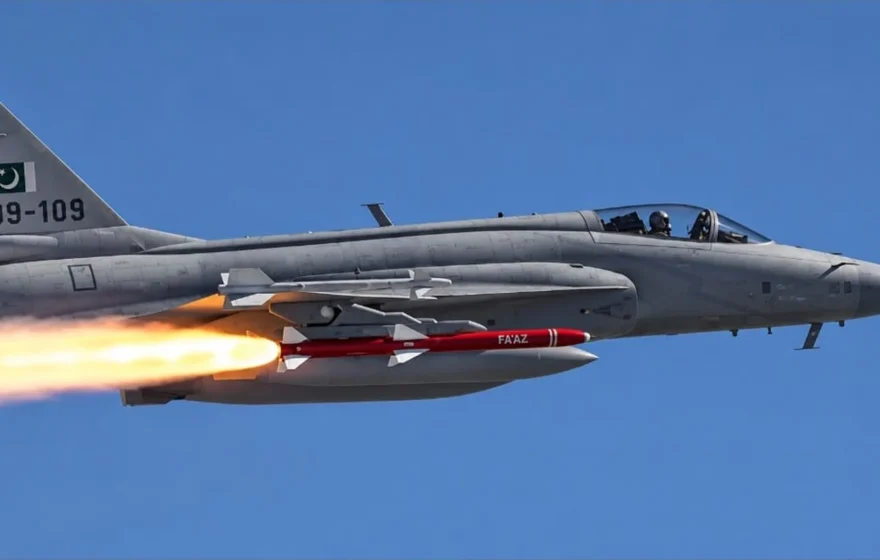
Pakistan has successfully flight-tested its first indigenously developed air-to-air missile, Fa’az, in a development the military has described as a major step forward for the country’s aerospace and defence capabilities. The test, announced on Tuesday by the military’s media wing, marks the first time Pakistan has flown a weapon of this kind designed and built at home.
The Inter-Services Public Relations, known as ISPR, said the missile is fitted with an advanced terminal guidance system that allows it to engage aerial targets at longer ranges. Terminal guidance refers to the guidance used in the final stage of a missile’s flight, when it homes in on its target, and ISPR presented it as a key feature of the new weapon. The statement said Fa’az would significantly enhance the operational flexibility of the Pakistan Air Force and further strengthen the country’s overall defence posture.
According to ISPR, the successful flight test demonstrated the technical maturity, innovation and self-reliance achieved by Pakistan’s defence industry. Senior officers of the armed forces, together with scientists and engineers who worked on developing the system, watched the launch. President Asif Ali Zardari, Prime Minister Shehbaz Sharif, the Chief of Defence Forces and Chief of the Army Staff, Field Marshal Asim Munir, and the service chiefs congratulated the scientists and engineers involved, according to reports of the announcement.
Video released with the announcement showed the missile leaving a JF-17 fighter jet, according to Dawn’s reporting, although ISPR itself did not name the launch aircraft in its statement. The JF-17 Thunder, jointly developed by Pakistan and China, remains a central part of the Pakistan Air Force’s modernisation programme, and the footage therefore drew particular attention from defence observers. ISPR also did not disclose the missile’s maximum range, speed, dimensions or other technical specifications, and gave no timeline for when the weapon might enter operational service.
That caution is normal for a first flight test, and it leaves several questions open. Defence analysts believe the variant tested was the Fa’az-IIR, fitted with an imaging infrared seeker, but ISPR has not confirmed that identification. Published specifications from Global Industrial and Defence Solutions, the state-owned company that markets such systems, list earlier Faaz variants at more than 100 kilometres and Mach 3.5, and a later Faaz-2 at 180 kilometres, but those are manufacturer figures, not figures confirmed by ISPR for this test, and they should not be treated as the official performance of the missile flown on Tuesday.
The longer history of Fa’az helps explain why the test matters. Mock-ups of the Faaz-RF and Faaz-IIR variants were first publicly showcased at the International Defence Industry Fair in Istanbul in July 2023, giving defence watchers an early glimpse of the programme. Analysts attribute development to the National Engineering and Scientific Commission, likely through its Air Weapons Complex, although ISPR has not confirmed that organisational detail either. What the test does confirm is that a programme once seen only as a display model has now reached the stage of a successful flight.
An air-to-air missile is a very different challenge from the surface-to-surface missiles Pakistan has tested more often. It must be carried safely under a fast-moving aircraft, released cleanly, guided towards a target that may itself be moving and manoeuvring, and then strike with precision, all in a matter of seconds. A country that can build such a weapon at home reduces its dependence on foreign suppliers for a critical part of its air power, gains greater freedom to adapt the weapon to its own aircraft and tactics, and builds the engineering base needed for future systems. That is why ISPR framed the test in terms of self-reliance, not simply as another successful launch.
The test also fits into a busy period for Pakistan’s missile programme. Last month, Pakistan tested two surface-to-surface missiles: the extended-range Fatah-IV ground-launched cruise missile, tested about a week before the Fatah-2 extended-range hypersonic ballistic missile on 13 October. The Fa’az test extends that activity into the air domain, and together the three tests present a picture of a defence industry working across land and air systems at the same time. Each test, however, stands on its own merits, and the air-to-air test should not be read as a direct answer to any single event.
For the Pakistan Air Force, the practical question now is what happens next. A successful first flight test is a milestone, not a finished capability. Further testing will be needed to prove reliability, to check performance across different ranges and conditions, and to integrate the weapon fully with the aircraft and tactics that will use it. Only after that process can a decision be taken on production and induction into service, and ISPR has given no timetable for those steps.
The wider significance, for now, lies in the signal the test sends. Pakistan has shown that its engineers can design, build and fly an air-to-air missile, a category previously dominated by a small number of producing countries. Whether Fa’az becomes a standard weapon for the Pakistan Air Force will depend on the testing programme that follows. But the first flight itself is the moment a long-running programme moved from the exhibition hall to the sky.
