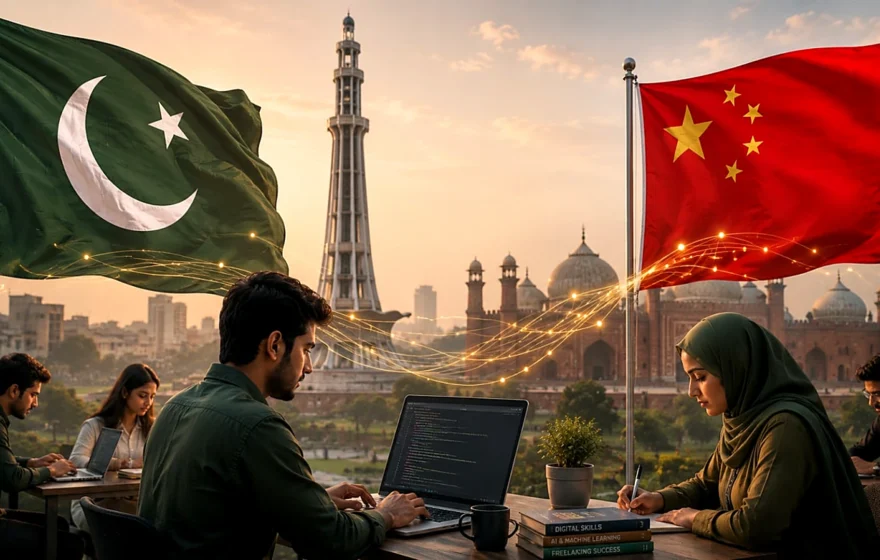
Pakistan has returned from China with a substantial new package for its young people, after a visit that produced eleven cooperation agreements and fourteen skills and education projects with Chinese institutions. The outcome, announced after the 27 October to 3 November visit of Rana Mashhood Ahmad Khan, chairman of the Prime Minister’s Youth Programme, is aimed at widening access to international qualifications, practical training and real jobs.
Its centrepiece was Pakistan’s showing at the 27th China Annual Conference and Expo for International Education, known as CACIE 2026. According to a press release cited in the announcement, Pakistan recorded the highest number of signings among the countries taking part, suggesting its institutions arrived as active participants with proposals ready.
The eleven agreements, signed or witnessed by the youth programme chairman, cover a deliberately broad spread of fields: mechatronics, green energy, mobile communications, nursing, modern agriculture, cross-border e-commerce and international skills certification. Instead of concentrating on a single trade, the package tries to match training to sectors where Pakistan is already changing, from its energy transition and digital economy to agriculture, health care and manufacturing.
Of the eleven agreements, the Prime Minister’s Youth Programme is directly a party to three, signed with the China Global Professional and Technical Certification Center, Jilin Electronic Information Vocational and Technical College, and Peili Vocational College. The remaining eight involve the University of Lahore, Ghazi University, NUTECH Karachi, the Preston Institute of Management Science and Technology, and the Punjab Technical Education and Vocational Training Authority, known as TEVTA, working with Chinese vocational partners. The mix links degree-level education with the hands-on training system most young jobseekers actually pass through.
Alongside the agreements came fourteen flagship initiatives, including an International Nursing Talent Training Base, a Cross-Border E-Commerce Talent Training Base, Pakistan Tiangong College, a Joint Teacher Training Centre, and new committees on Industrial Robotics and Electronic Information Engineering. Each points to a different gap: nursing to global demand for health workers with recognised qualifications, e-commerce to young people earning online, and robotics and electronics to workshops that need staff who can operate and maintain modern equipment.
One of the most concrete employment threads concerns the railway sector. Han Hui, secretary of China Railway Group, flew to Pakistan on the same day, following strategic discussions with the youth programme chairman, to begin on-the-ground work on skills training and employment linked to the Main Line-I railway upgrade, known as ML-1. This is the link trainees often ask for first: not just a certificate, but a visible project where it leads to work.
Early results are already visible in one partnership. Jilin Electronic Information Vocational and Technical College has already trained ten Pakistani faculty members, and it will enrol fifteen Pakistani students in its Chinese language programme from November. Teachers first, then students, is a sensible sequence, and language preparation should make later study in China more durable.
The green energy strand carried a similar practical emphasis. The chairman co-launched the International Green Power Talent Development Base with the China Electricity Council, Thailand’s Office of the Vocational Education Commission and TANG International Education Group, aimed at strengthening cooperation in green energy skills. He also addressed the Belt and Road International Forum on Industry-Education Cooperation and the International Seminar on Green Energy Talent Exchange, stressing the need to align training with industry requirements, promote joint programmes, introduce internationally recognised certifications and strengthen teacher training. The repeated emphasis points to a familiar weakness: courses designed in isolation from employers, producing graduates whose certificates employers do not trust.
Diplomacy formed another part of the trip. The chairman met Pakistan’s ambassador to China, Ali Asad Gillani, and senior embassy officials to discuss support for education and skills partnerships, and held separate talks with Benjawan Pokpong of Thailand’s vocational education commission on expanding collaboration among Belt and Road partner countries. He also presented the China-Pakistan International Education Cooperation Awards for 2025-2026 under the auspices of the Embassy of Pakistan in Beijing. To keep the strands together, a PMYP China Secretariat has been established at the Beijing headquarters of TANG International Education Group, to coordinate government departments, institutions and industry partners. It will only prove its worth in the months ahead, when agreements must turn into timetables, admissions, curricula and examinations.
The chairman said youth empowerment remained a key priority of the government under Prime Minister Muhammad Shehbaz Sharif, advancing the vision of a Skilled, Empowered and Digital Pakistan, and that every student enrolled and every teacher trained is a step towards a stronger, more skilled Pakistan. That vision will be judged by outcomes young people can feel: whether courses open on time, whether certificates help in a job interview, whether training leads to work on projects such as ML-1, and whether the new bases for nursing, e-commerce, green power and robotics become working institutions rather than announced names. The November enrolment and the start of ML-1 skills work will be the earliest tests, and if they proceed, the visit will have given Pakistan’s skills system new partners, new standards and a clearer route from classroom to workplace.
