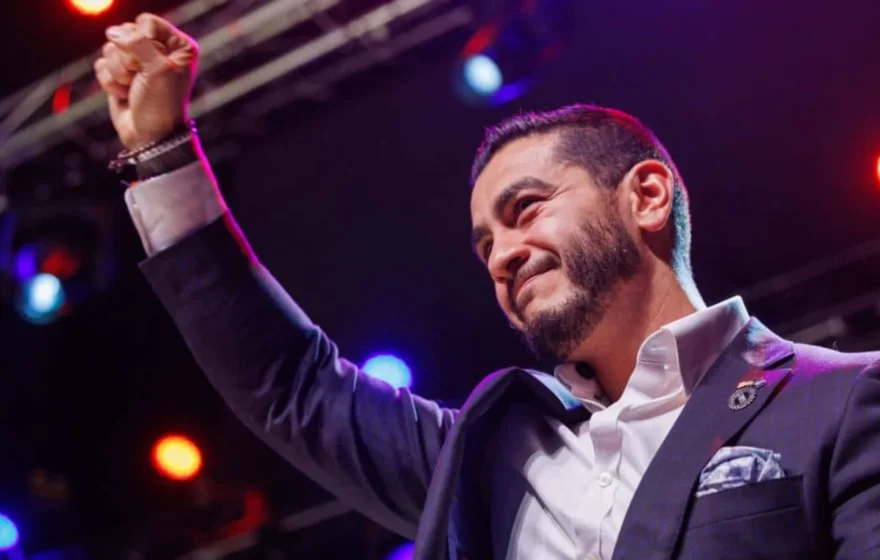
Democrat Abdul El-Sayed has declared victory in Michigan’s race for the United States Senate, putting him on course to become the first Muslim elected to the chamber in American history. Addressing supporters on election night, he described himself as senator-elect while holding a substantial lead over his Republican opponent, former congressman Mike Rogers, in the contest to succeed retiring Democratic Senator Gary Peters.
The result, projected by Decision Desk HQ and Fox News, was called in the early hours of Wednesday, after a campaign that had become one of the most closely watched and expensive contests of the 2026 midterm elections. With about 77 per cent of the expected vote counted, El-Sayed had secured 1,995,543 votes, or 51.8 per cent, against 1,779,101 votes, or 46.2 per cent, for Rogers, according to the figures reported on election night. About 1.1 million votes were still outstanding at that stage, and Rogers would have needed about 58.7 per cent of the remaining ballots to overtake El-Sayed, according to NBC News calculations reported at the time. The Associated Press later recorded a called race, with El-Sayed ahead.
El-Sayed, a physician and epidemiologist, campaigned on universal healthcare, lower everyday costs and support for workers. He also brought experience from leading public health agencies in Detroit and Wayne County, a record he placed at the centre of his campaign. He directed the Detroit Health Department from 2015 to 2017, and later led Wayne County’s Department of Health, Human and Veterans Services from 2023 to 2025. For voters, that background was presented not as a detail on a CV, but as evidence of how he would approach government: as a public health problem to be solved, with services that reach people where they live.
Before entering electoral politics, El-Sayed built a career in medicine, research and teaching. He earned his medical degree from Columbia University and completed a doctorate in public health at Oxford University as a Rhodes Scholar. He also taught epidemiology at Columbia and hosted a podcast focused on public health, work that gave him a national profile long before he first stood for office. He first gained wider attention during his progressive campaign in Michigan’s 2018 Democratic primary for governor, a race he did not win but which established him as a voice on the left of the party.
His path to the nomination was hard fought. In 2026, he defeated US Representative Haley Stevens in the Democratic primary, after a divisive contest in which he narrowly beat the establishment-backed congresswoman. The general election against Rogers was no easier. Rogers, a former seven-term congressman, was making a second attempt at a Senate seat after losing Michigan’s other Senate race to Democrat Elissa Slotkin by fewer than 20,000 votes in 2024, hoping to become the first Republican elected to the Senate from Michigan since 1994.
The campaign was marked by sharp attacks. El-Sayed faced allegations about Muslim Brotherhood connections and accusations of antisemitism, which he rejected, and criticism of his opposition to American military assistance to Israel. President Donald Trump branded him a dangerous jihadist, while former President Barack Obama rallied behind him. In the final days, Stevens came out in support of Rogers, a last-minute defection El-Sayed’s campaign had to weather.
Healthcare remains central to El-Sayed’s platform. He advocates universal coverage and co-authored a citizen’s guide to Medicare for All, arguing that a system in which care depends on income or employment leaves too many people behind. His economic agenda focuses on reducing the costs families face in daily life, supporting labour unions, and reducing corporate influence over politics. He has also highlighted a medical debt relief initiative that he credits with eliminating 700 million dollars in debt for Michigan residents, and efforts to remove lead from schools and provide children with free eyeglasses.
The historic significance of the result is clear, even as the final vote count continues. No Muslim has previously served in the United States Senate, and El-Sayed, the 41-year-old son of Egyptian immigrants, would break that barrier. He is also set to become the first Democratic doctor in the Senate since 1969, according to reports of the result. For Michigan, the outcome keeps Peters’ seat in Democratic hands, in a state that has not elected a Republican senator since 1994, and adds to the party’s position in the chamber following other midterm wins.
El-Sayed himself has sought to frame the result in broader terms than identity alone. Before the election, he said he was not running to be the first Muslim senator in American history, but to be Michigan’s next senator, a line that captured his campaign’s attempt to keep the focus on healthcare, costs and workers. His supporters, however, celebrated the history as well as the politics, and his victory speech was heard by many as a moment of recognition for Muslim Americans.
What happens next will be watched in Washington, where he will bring a public health background and progressive priorities to debates on healthcare costs, workers’ rights and corporate money in politics. For now, the story is the result itself: a former Detroit health director has won one of the country’s most important Senate races, and is set to make history when he takes his seat.
