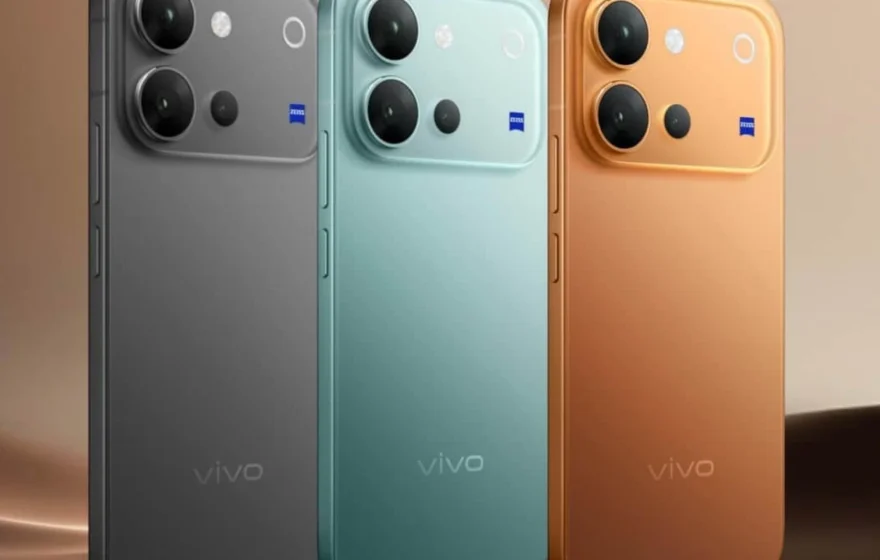
Vivo is getting ready to bring the Vivo V80 to Pakistan, with the phone expected to reach shops here in November 2026. The company has already put up a pre-launch page on its Pakistani website, listing a 7,200mAh battery, a 144Hz AMOLED screen and cameras tuned with the German optics house ZEISS. What is still missing is an official launch date and a confirmed price, and until Vivo announces those, the phone remains a promise rather than a product on the shelves.
Design and Display
The V80 is built around a 6.59-inch AMOLED display with a 1.5K resolution, which works out to 2750 by 1260 pixels. The screen refreshes at up to 144 times a second, so scrolling and swiping feel smooth, and it can reach a local peak brightness of 5,000 nits, useful in bright sunlight. At the other end of the scale it can drop to just 1 nit, so late-night reading does not strain your eyes, and the bezels are just 1.25mm thick.
The body carries a glass back and a redesigned camera module, and it is rated IP68 and IP69 for dust and water resistance, a level of protection once reserved for far more expensive phones. Vivo has confirmed three colours for Pakistan, called Rise Orange, Vision Green and Prime Gray.
Processor, Storage and Software
Under the hood, the V80 is expected to run on Qualcomm’s Snapdragon 7 Gen 4 processor, the same chip that powered its predecessor, the Vivo V70. That is both good news and a small disappointment: the chip is proven and capable, but buyers upgrading from the V70 will find no extra speed in the new model. Vivo has clearly decided the V80 is a refinement of the V70 rather than a leap forward, putting its effort into the battery, the cameras and the design instead.
The phone runs Android 17 with Vivo’s OriginOS 7 on top, and it brings a set of artificial intelligence tools with it, including an AI Recorder, a Capture to Note feature and a Security Shield. The AI Recorder can turn spoken words into text, while Capture to Note pulls useful information from what is on screen. Vivo has promised six years of security updates, counted from the phone’s first global launch, a generous commitment in a market where many phones are forgotten by their makers within two or three years.
For storage, Pakistan will get the 256GB and 512GB versions, while the 128GB model will not be sold here at all. The 256GB version should be enough for most people, while the 512GB option gives heavy users room to breathe, especially those who shoot a lot of 4K video.
Camera Specifications
The cameras are where Vivo has spent most of its effort, and the V80 carries a ZEISS-branded triple camera system on the back. The main camera uses a 50MP Sony LYTIA 700V sensor with optical image stabilisation. Next to it sits a 50MP Sony IMX882 periscope telephoto camera, offering 3x optical zoom and up to 100x digital zoom. The third camera is an 8MP ultrawide for landscapes and group shots.
The front camera is a 50MP ZEISS selfie camera with autofocus and a 92-degree field of view, wide enough for group shots. Both the front and rear cameras can record 4K video at 60 frames per second, and the phone includes ZEISS portrait modes at 85mm and 100mm focal lengths that mimic the look of a professional portrait lens.
Battery and Expected Price
The battery is the other big story. The V80 packs a 7,200mAh cell, the largest ever fitted to a V series phone, and a clear step up from the 6,500mAh battery in the V70. It uses fourth-generation silicon-carbon technology, and the phone itself stays slim at 7.6mm thick. Vivo says the battery can last up to 14 hours of navigation and 39.5 hours of local video playback. Charging is handled by 90W FlashCharge, which Vivo claims can take the battery to half full in about 30 minutes.
As for price, the report by WhatMobile puts the V80 between Rs. 214,999 and Rs. 219,999 in Pakistan, though Vivo has not confirmed anything yet. For comparison, the phone launched in India in early October at INR 62,999 for the 8GB RAM and 128GB storage version, with the 256GB model at INR 69,999 and the 512GB version at INR 79,999. Pakistani prices run higher once taxes and import duties are added, so a figure near Rs. 215,000 would be in line with expectations.
That price puts the V80 firmly in the premium mid-range, where rivals offer similar screens and chips. What sets it apart is the combination of the huge battery, the ZEISS cameras and the six years of security updates. Buyers who already own a V70 may struggle to find a reason to upgrade, but anyone coming from an older phone will find a big step up in battery life, screen quality and portrait photography. The real test will come when Vivo announces the official price, because in this price bracket a difference of ten or twenty thousand rupees can decide whether a phone sells well or gathers dust on shop shelves.
