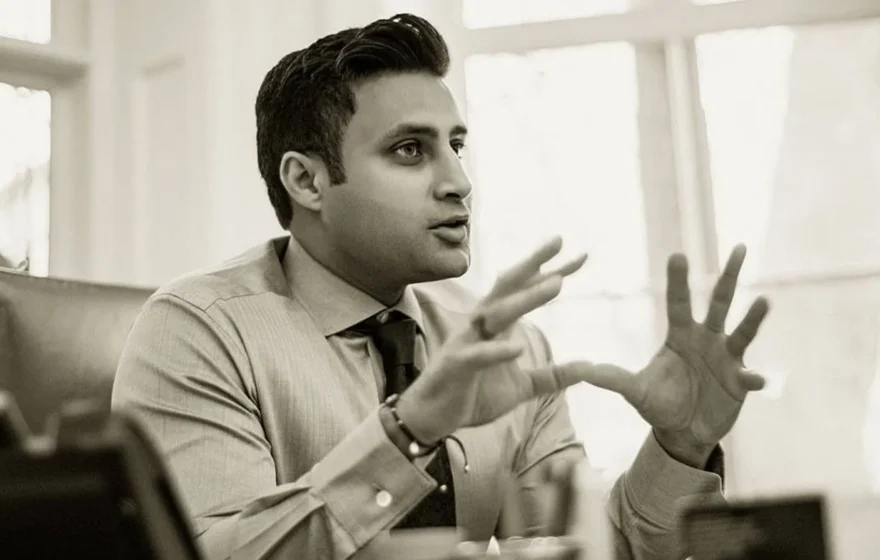
British-Pakistani politician Zulfi Bukhari has been named among ten influential figures from around the world in a new list published by a London magazine, alongside some of the most talked-about young leaders in global politics. The Luxurist included Bukhari in its selection, titled The New Generation of Global Politicians Changing the Face of Power, and he is the only Pakistani on the list.
The magazine said the list highlights politicians winning international attention through modern communication, a strong presence online, and an ability to speak directly to younger voters. Rather than choosing leaders purely on the office they hold, it looked for people changing how politics is done and building followings that cross national borders. Bukhari was picked on that basis, with the magazine citing his international connections, business background, and ease with people from very different cultures.
Bukhari is one of the best-known faces of Pakistan Tehreek-e-Insaf outside Pakistan. Born in the United Kingdom in 1980, he grew up between London and Pakistan, and his family roots lie in Attock in Punjab. Before entering politics, he made his name as an entrepreneur in Britain, working in property and hospitality, founding HPM Developments, a luxury real estate firm in London. He also served as executive producer of Cake, the 2018 Pakistani film chosen as the country’s entry for the best foreign language film at the Academy Awards.
His political rise came through a close association with former prime minister Imran Khan. Bukhari had been an active member of the PTI since 2011, and he managed Khan’s campaign in the Islamabad constituency of NA-53 in the 2018 general election. After the PTI came to power, he was appointed as a special assistant to the prime minister on overseas Pakistanis and human resource development, as a minister of state. He served from September 2018 until May 2021, when he stepped down amid controversy over the Rawalpindi Ring Road project, although he was later cleared and restored to party positions. In September 2022, he gave up his British citizenship, and he now serves as the PTI chairman’s adviser on international media.
The magazine’s profile drew heavily on that life between two countries. It called him a strategic thinker with a wide network across business, media and public affairs, and it argued that his upbringing in London and Pakistan had left him unusually well placed to connect with younger Pakistanis and the large overseas Pakistani community. The magazine suggested that his cosmopolitan outlook and contemporary style of communication made him a good example of a new kind of globally connected Pakistani political figure, whose appeal rests on reaching a diaspora audience that many Pakistani politicians struggle to reach.
The best-known name alongside him is Zohran Mamdani, the mayor of New York City, who won the election in November 2025 after a campaign built on social media and volunteers, beating former governor Andrew Cuomo. He took office in January 2026 as the city’s first Muslim mayor, its first mayor of South Asian heritage, and its youngest in more than a century. Also on the list is Alexandria Ocasio-Cortez, who entered the United States House of Representatives in 2019 at 29, after defeating a ten-term incumbent in a Democratic primary, becoming the youngest woman ever elected to Congress. American politician Abdul El-Sayed is also featured.
From South America comes Daniel Noboa, the president of Ecuador, who first took office in November 2023 at 35, the country’s youngest ever president, and won a full four-year term in the 2025 election. Another familiar name is Balendra Shah, the Nepalese politician known as Balen, a former rapper who won the race for mayor of Kathmandu as an independent in 2022, before becoming Nepal’s prime minister after his party’s landslide in the March 2026 elections. India’s Tejasvi Surya, the Bharatiya Janata Party MP for Bangalore South since 2019, is also included, along with Taiwan’s Huang Jie, Brazil’s Eduardo Leite and Malta’s Eve Borg Bonello.
The list is a magazine’s judgement rather than an election result, and it should be read in that light. Yet it captures something real about the way politics is changing. Across the ten names, the common thread is not ideology, since the group runs from democratic socialists to conservatives, but method. Each has built a public identity that does not depend on the old routes to power, through party machines and traditional media, and each speaks to an audience that consumes politics mainly on a phone screen.
For Pakistan, Bukhari’s inclusion carries a particular meaning. He holds no elected office at present, and his standing rests largely on his closeness to Imran Khan and his role as a bridge to the overseas community. A place on an international list does not change that, and it will not settle the cases he faces at home. What it does show is that there is an audience abroad for a politician who can operate comfortably in London, Dubai and Islamabad at once, and speak to a diaspora that sends home billions of dollars a year. That reach is a genuine asset few of his rivals can match.
