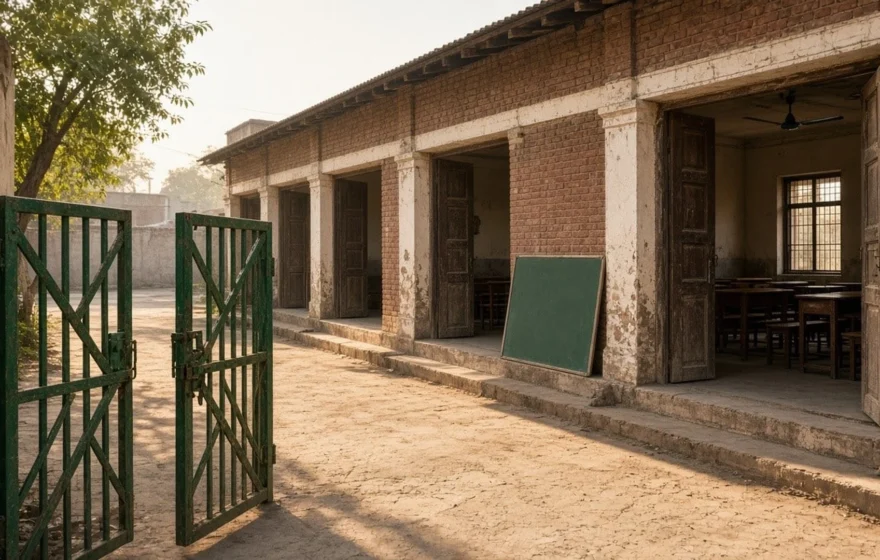
The education department in Charsadda has told government schools in the district that no one may take photographs or record video on their premises without permission first, a decision that has landed at the very moment journalists across Khyber Pakhtunkhwa are drawing attention to the poor state of many of those same schools.
According to a notification issued by the District Education Officer (Male) in Charsadda, prior approval from the district education officer is now required before photography, videography or other activities can take place inside a public-sector school. The order applies to anyone wanting to record images or footage in a government school in the district, including members of the media.
The timing of the decision is what has given it weight beyond a routine administrative instruction. Reporters in Khyber Pakhtunkhwa have spent recent weeks highlighting conditions in government schools, from overcrowded classrooms to missing facilities. Against that background, the new requirement has raised concern that independent reporting on those conditions could now be slowed down or shut out altogether, since every visit involving a camera would first need approval from the department responsible for the schools being filmed.
The schools at the centre of that reporting make the concern easy to understand. At Government Primary School Paindakhel in Charsadda, around 380 children share just three classrooms, a squeeze so tight that many pupils are forced to attend their lessons outdoors. The school has only two washrooms, one of them reserved for teachers, which leaves a single washroom for all of the children. It is the kind of detail a photograph conveys in seconds.
The picture is similar a short distance away at Government Primary School Majoki, where more than 300 children are packed into five classrooms. There is no separate office for the headmaster, so he has arranged a makeshift workspace behind a curtain inside one of the classrooms, and the school’s important records are kept there too. The building sits considerably lower than the adjoining road, so rainwater collects on the premises and sometimes stays for weeks, disrupting classes.
These are not isolated cases: across Charsadda, government schools face the same shortages — too few classrooms and washrooms, missing boundary walls, no clean drinking water and a lack of other essential facilities. The district’s problems sit inside a much larger provincial picture. Official figures reported this month put the number of children out of school in Khyber Pakhtunkhwa at 4.9 million, including two million boys and 2.9 million girls, drawn from a Pakistan Institute of Education report that counted more than 25 million out-of-school children across the country. The same figures counted 44,747 vacant teaching posts in the province and 562 schools that are not functioning at all, along with 17,353 classrooms in need of reconstruction and another 18,476 in need of major repair.
The province has tried to respond. The education department said 1,053 schools were running double shifts to take in more than 70,000 extra students, and that 830,000 children had been enrolled during the year, including 315,000 girls. The provincial education budget stood at Rs364 billion, with Rs19 billion set aside for development work. Yet the gap between those plans and the daily reality in places like Paindakhel and Majoki remains wide, and it is that gap which journalists have been documenting.
That is why the photography rule has struck a nerve. Khyber Pakhtunkhwa has long presented itself as a leader on openness in government: its Right to Information Act of 2013, passed under Article 19-A of the Constitution, gives every citizen the right to seek information and records held by public bodies. The Constitution also guarantees free and compulsory education for children aged five to 16. A notification that requires officials to approve photography inside public schools does not cancel those rights, but it sits uneasily beside them, because the public’s ability to see the state of a government school depends on someone being able to walk in with a camera.
Supporters of such rules usually argue that permission systems protect children, prevent disruption during lessons and stop strangers wandering through school grounds. Those are real concerns. The question is how the rule is applied in practice: whether permission is granted quickly and fairly to journalists who want to show what is happening inside a public institution, or whether it becomes a filter that keeps uncomfortable images out of public view while the problems behind them go unaddressed.
The notification gives no public detail about how long an approval will take, what reasons could justify a refusal, or whether there is any appeal. Until those questions are answered, the order will be judged by what happens next. If reporters who apply are allowed in promptly and the schools’ shortages begin to be fixed, the rule may come to look like a reasonable safeguard. If requests are delayed or refused while classrooms stay overcrowded and rainwater keeps pooling in schoolyards, it will be read very differently, as a barrier put up between the public and the schools its taxes pay for.
