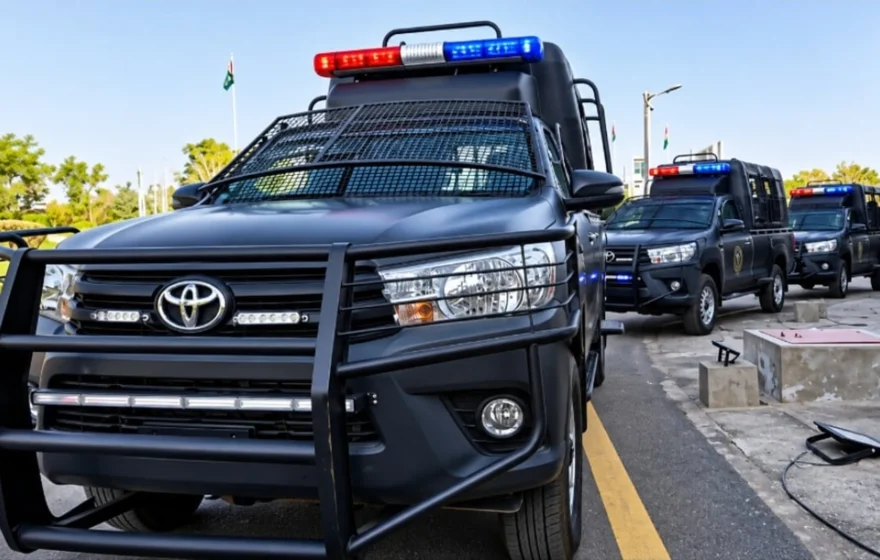
Federal Interior Minister Mohsin Naqvi has handed over 20 new vehicles to the Islamabad Police's Special Weapons and Tactics (SWAT) Force, giving the capital's youngest elite unit the mobility it needs to reach an emergency in time. The minister went further at the handover ceremony on Friday, announcing that another 20 vehicles would follow, taking the total number of new vehicles for the force to 40.
The Ministry of Interior organised the ceremony to mark the formal transfer of the vehicles. Naqvi inspected the new fleet, met the SWAT personnel who will use it, and handed the symbolic key to the Inspector General of Islamabad Police. Senior officers from the capital police were also present as the vehicles were formally placed at the force's disposal.
Naqvi told the gathering that the SWAT Force would act as the first responder in any emergency, moving first and taking immediate action while other units follow. He said the new vehicles would make that role real, letting teams move faster across a sprawling city, carry their equipment with them, and stay on the scene as long as an incident demands. The promise of 20 more, he added, was meant to make sure the force does not run short of transport just as it is finding its feet.
A SWAT unit is not ordinary patrol policing. Its teams are selected, trained and equipped for situations beyond the reach of a normal police response: armed standoffs, hostage incidents, attacks on crowded public places and the first chaotic minutes of a terrorist strike, when speed and discipline matter more than numbers. That is why the force's vehicles matter as much as its weapons: a specialist team that cannot reach the scene quickly is of little use, however well trained.
The force itself is less than a year old. Its first unit passed out at the Police Lines in Islamabad on 13 February this year, with Naqvi attending as chief guest, in a ceremony presented as a milestone for the capital. The graduating batch included 25 women and 20 personnel from the Christian community, a mix the ministry said showed the new force reflecting the city it serves. More than 200 personnel were inducted into the unit when it was raised.
Building it took outside help: the Islamabad Police turned to the Pakistan Army, which placed two majors and 16 commandos from the elite Special Services Group at the capital police's disposal to train the new force. The training compressed a six-month course into three months of day-and-night work, and the unit was placed under the supervision of the Counter Terrorism Department. It was an admission that the capital had been trying to police a modern threat with a force designed for something else.
Naqvi made the point plainly at the passing-out parade in February, saying that until then Islamabad had no practically trained force specifically prepared to combat terrorism, and that the capital's officers had taken the initiative themselves, working with the Army to build one from scratch. The force, he said, had been formed at a critical time, and the discipline on display that day suggested the investment had been worthwhile.
Those challenges were brought home to the capital on 11 November last year, when a suicide bomber struck outside the District Judicial Complex in the G-11 sector. The attacker, unable to get through the security cordon, detonated his explosives beside a police vehicle at 12.39pm, killing 12 people and injuring 36, according to hospital officials. The blast came while Islamabad was hosting the Inter-Parliamentary Speakers' Conference and the Margalla Dialogue, and it was a reminder that the capital itself is a target. A splinter faction of the Pakistani Taliban, Jamaat-ul-Ahrar, claimed responsibility for the attack.
The new vehicles are one part of a wider effort to rebuild the capital's security machinery around speed and technology. The Islamabad Safe City project is being turned into a Capital Smart City, with its second phase nearing completion and hundreds of kilometres of fibre-optic cable already laid. M-Tags have been mandatory for vehicles entering Islamabad since the start of this year, and the government has announced plans for compulsory electronic tags at entry points and a survey mapping every household in the capital. The idea is that cameras, data and a rapid-response force should work as one system rather than three separate ones.
Whether that system works will be judged not at ceremonies but at the next incident. Vehicles alone do not make an elite force, and a first responder is only as good as the intelligence that sends it to the right place and the training that steadies it when it arrives. But the direction of travel is clear. At the start of this year Islamabad had no dedicated counterterrorism unit at all; it now has a trained SWAT force, Army-trained instructors behind it, a surveillance network being rebuilt around it, and 40 new vehicles delivered or on the way. For a city that learned last November how quickly an ordinary day can turn, that is a promise residents will expect to be kept.
