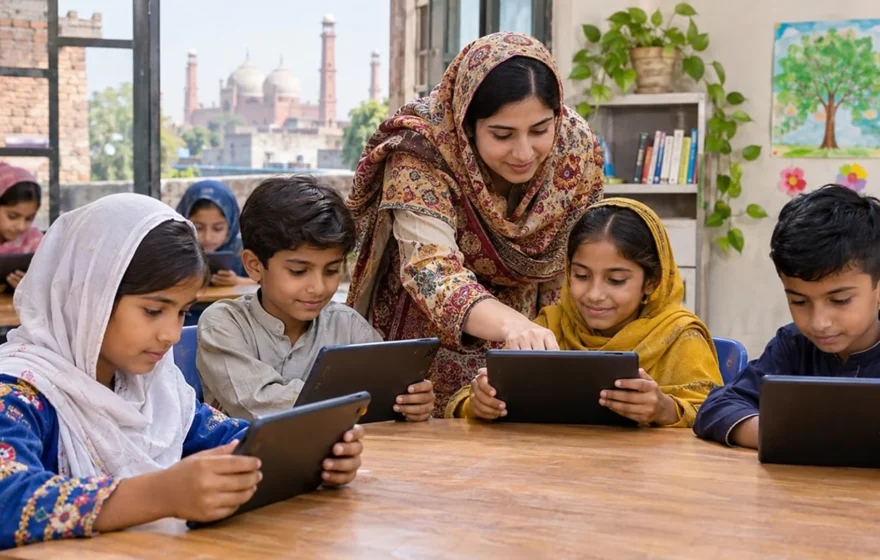
Lahore is set to get five new Digital MicroSchools that will use tablets and game-based learning to teach children in underserved communities, under an agreement between the Federal Education Foundation and the Teach the World Foundation. The two organisations have signed a memorandum of understanding to launch the initiative, with plans to extend the network to other districts across Pakistan once the first schools are running.
The schools are community-based learning centres rather than conventional classrooms. Children will work through interactive, game-based applications on tablets, developing basic reading, writing and maths skills at their own pace, with trained facilitators guiding them through the process instead of formal teachers standing at a blackboard. The idea is to reach children who have never been to school or who dropped out, and to give them a way back into learning that fits around their lives rather than demanding they fit into a system that has already failed them.
The partnership brings together two very different organisations. The Federal Education Foundation, a private-sector initiative announced in October 2026 by industrialist and former federal commerce minister Dr Gohar Ejaz, will provide the organisational framework and governance, overseen by a board representing all four provinces. The Teach the World Foundation, a non-profit set up in 2016, will manage the educational strategy, the digital learning model and the practical work of getting the schools running, with private-sector and community leaders also involved in improving access in the areas the schools serve.
The scale of the problem the two foundations are trying to address is enormous. More than 26 million children in Pakistan are out of school, according to figures from UNICEF, one of the largest out-of-school populations anywhere in the world. Many of them live in rural villages, urban slums and settlements where schools are distant, overcrowded or simply absent, and girls are affected more than boys. Conventional school-building alone has not closed the gap, which is why both foundations argue that a different model is needed alongside it.
The Teach the World Foundation already has experience of that model. It currently supports more than 25,000 students across over 250 digital schools in Pakistan, and independent assessments have reported improvements in foundational learning, including encouraging results among girls. Each Digital MicroSchool is a one-room community hub designed to serve around 100 to 125 children, running in four daily shifts so that a single small space can reach as many children as possible. The tablets come preloaded with content aligned to the national curriculum for grades kindergarten to five, and the schools are built to run without internet or grid electricity, using solar-powered charging and local servers to stay online.
That design matters in the communities the schools are meant to serve. A learning centre that needs a stable internet connection or a reliable power supply would be of little use in a village or settlement where neither can be taken for granted. By contrast, a solar-charged tablet with lessons already loaded on it can work anywhere, and a facilitator from the local community can run the sessions without the formal teaching qualifications that are in short supply in precisely these areas. The model is deliberately light, cheap and repeatable, which is what makes it possible to imagine it spreading beyond a handful of pilot sites.
The Lahore launch is the first phase of a much larger ambition. The joint venture agreement between Dr Ejaz and Shafiq Khan, the founder and chief executive of the Teach the World Foundation, was signed on November 14, and it sets out a plan to take the model to 170 districts across Pakistan, with local business leaders taking direct responsibility for bringing out-of-school children into education in their own districts. Under the framework, the chairman of the relevant chamber of commerce at district level would be designated as the district governor for the initiative, and the Federal Education Foundation had already announced plans to adopt a school in each of Pakistan’s 170 districts.
For now, the focus is on getting the first five schools open. The two foundations will finalise their operational arrangements in the coming weeks, and preparations are already under way to open the first five Digital MicroSchools in Lahore, with the first schools expected to begin operations within about four weeks. That makes Lahore the testing ground for a model that both sides hope to carry across the country.
The test will be a demanding one. Five small learning centres in one city will not, on their own, make a dent in a national crisis involving tens of millions of children. Their value lies in proving that the model works in practice, that children who have never sat in a classroom can learn to read, write and count through a tablet and a facilitator, and that the partnership between a business-led foundation and an education non-profit can keep those centres running once the launch publicity fades. If Lahore works, the road to the other districts becomes a question of organisation and funding rather than of proof.
