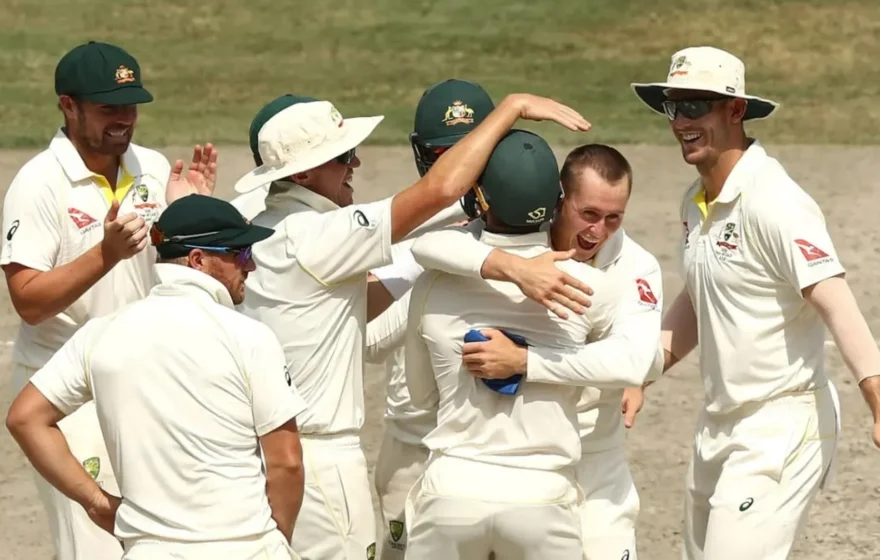
Fresh allegations have emerged that Australian players discussed tampering with the ball during a Test match against Pakistan in Dubai in October 2018, just six months after the sandpaper scandal in Cape Town that had already shaken Australian cricket to its foundations.
According to an investigation by the sports broadcaster Gerard Whateley, published by the Australian radio network SEN, the discussion took place during Pakistan’s first innings in Dubai, as Australia’s bowlers struggled to get any movement from the ball on a flat pitch. One player is reported to have asked the dressing room, “Who’s got the mints? Who’s doing the ball today?” The suggestion was that mints, sucked and then rubbed onto the ball, could be used to alter its condition and make it swing.
The report says the idea went no further. The then captain, Tim Paine, and the head coach, Justin Langer, stepped in to stop it, and a newer member of the squad spoke strongly against it, warning his teammates against repeating what had happened in Cape Town. After Cape Town, players had reportedly been forbidden from taking sweets onto the field, and Paine had given the support staff his word that he would not allow such practices under his captaincy. Whateley’s investigation describes the Dubai episode as the last time Australian players discussed manipulating the ball during a match.
The match itself was a punishing one for Australia’s bowlers. Pakistan piled up 482 in their first innings, with openers Mohammad Hafeez and Imam-ul-Haq putting on 205 for the first wicket, and the Australian attack found almost nothing in the conditions. The game ended in a draw, with Australia clinging on at 362 for eight in pursuit of 462, thanks largely to Usman Khawaja’s 141 from 302 balls. Pakistan won the second Test in Abu Dhabi by 373 runs, with Mohammad Abbas taking 17 wickets in the series at an average of 10.59.
The Dubai claims cannot be understood without the scandal that came before them. On March 24, 2018, during the third Test against South Africa at Newlands in Cape Town, television cameras caught the Australian opener Cameron Bancroft rubbing the ball with a small yellow object, later admitted to be sandpaper. At the press conference that evening, Bancroft and the captain, Steve Smith, admitted the ball had been tampered with, although they first described the object as tape with dirt stuck to it. Smith said the plan had been discussed by the team’s leadership group during the lunch break.
The punishment was the heaviest in the sport’s modern history. Cricket Australia banned Smith and his deputy, David Warner, for twelve months from international and domestic cricket, and Bancroft for nine months. The coach, Darren Lehmann, stepped down even though he was found not to have been directly involved. Paine took over as captain, and Australia lost the Test by 322 runs and the series 3-1.
For eight years the official version was that knowledge of the plan was confined to those three players. That version has collapsed in recent weeks. In his memoir, published in November 2026, Khawaja wrote that sandpaper had also been used in the second Test of that series, in Port Elizabeth, and that every member of the touring party knew about the plans. His teammates Warner and Chadd Sayers have since confirmed his account. Days later, Bancroft published a 4,000-word statement saying the whole team had known, and admitted he had withheld important information from the original investigation. Cricket Australia has responded by announcing an independent forum where players can speak openly, a belated attempt to draw a line under a scandal that refuses to fade.
Whateley’s report also sheds light on the atmosphere inside the Australian dressing room in the months after Cape Town. It describes Mitchell Marsh confronting Warner at the team hotel, urging him to take responsibility for his part rather than letting Bancroft carry the blame alone. There were also disagreements over whether the whole squad should accept collective responsibility. The picture is of a team still arguing over who knew what, long after the bans had been served.
The current Australian captain, Pat Cummins, has repeatedly denied having any prior knowledge of the plan, and the fast bowler Josh Hazlewood has defended him. The latest claims remain allegations reported in Whateley’s investigation, not confirmed by Cricket Australia or the players involved.
What is striking about the Dubai episode is how quickly the habit of thinking about it returned. Six months after the most public disgrace in Australian cricket’s history, with bans served and a new captain in place, a player was still asking who had the mints. That the suggestion was shut down by the captain and coach themselves matters. But so does the fact that it was made at all, in a dressing room that had promised itself it would never go there again. For Australian cricket, the question is no longer just what happened in Cape Town, but how deep the culture that produced it really ran, and whether the forum Cricket Australia has now promised can finally give the whole story.
