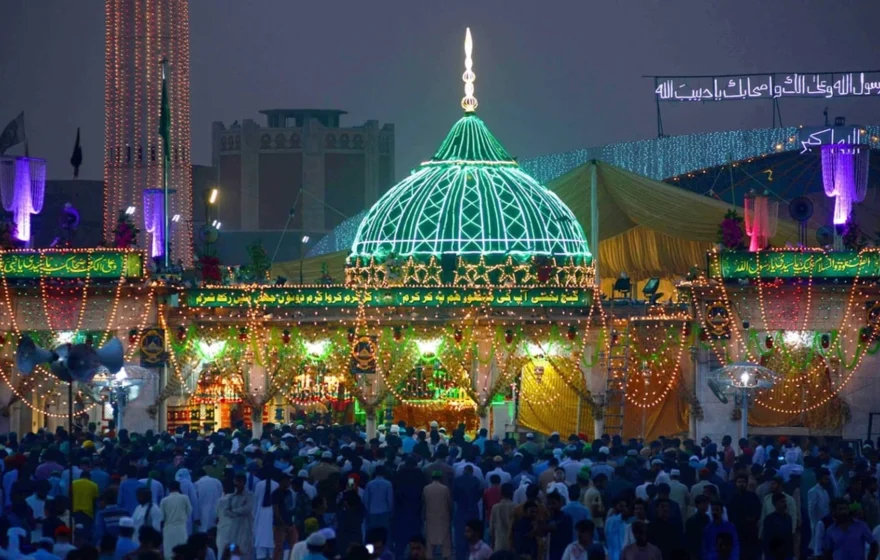
The expansion, restoration and renovation of Lahore’s Data Darbar has become more expensive and will take longer than first planned, with the Punjab government now fixing June 2027 as the new date for its completion. The cost of the work has risen by Rs 2 billion to Rs 8 billion, a sharp increase for a project that was originally supposed to finish in 2024 and now stands as one of the most closely watched religious construction schemes in the province.
Auqaf Director General Hafiz Aneesur Rehman said the increase came from changing requirements and the need to provide better facilities for the growing number of visitors.
The delays have had several causes. Administrative issues slowed decisions, the design was changed more than once to fit a larger crowd, and legal proceedings dragged on over the properties around the shrine. Those properties had to be acquired before parts of the complex could be extended, and the Auqaf Department has now secured possession of the land, allowing construction to proceed in phases. A committee of the Auqaf Department, the engineering consultancy NESPAK and the construction firms has been formed to speed up decorative work, including the restoration of arches, latticework and calligraphy, and the government has ordered the prompt repair of cracks in the green tiles of the main dome and the white tiles of eight smaller domes.
Authorities have been directed to speed up construction and to make sure all 21 computer-controlled cutting machines assigned to the project remain in operation. Previously only four to six of the machines were working at any one time, and the slow pace of cutting and shaping stone and marble held the whole scheme back. Construction is now continuing around the clock in multiple shifts, according to the Auqaf Department.
When the work is finished, visitors should find a shrine that can hold far more people in comfort. The expansion will provide a larger courtyard and improve arrangements for prayers and for the annual Urs, the three-day festival marking the death anniversary of the saint, which draws up to a million devotees. The revised design also includes basement parking, an underground passage connecting the main road to the shrine, and a modern langar facility where free food is served. Work outside the shrine, including a piazza, sitting areas and a modern parking facility, is being handled by the Traffic Engineering and Transport Planning Agency, which has been told to finish the external development by March 31, 2026.
One delicate part of the project concerns a piece of the shrine’s own history. The golden door installed during the tenure of former prime minister Zulfikar Ali Bhutto will be moved to make way for the expanded courtyard. It will be refurbished before being installed at a new position, so a feature devotees have known for decades is preserved rather than lost in the rebuilding.
The project in its current form began in February 2024, when caretaker chief minister Mohsin Naqvi laid the foundation stone for the extension of the Data Darbar complex. The scheme was then priced at about Rs 6.5 billion, with the National Logistics Cell carrying out the construction and the Madina Foundation undertaking the extension of the main shrine building. The plan included extending the prayer hall to create space for 1,000 more worshippers and remodelling the busy Bhatti Chowk junction beside the shrine. Officials said then that the work would take three years, though they hoped it could be finished in two. That hope has now faded, and June 2027 is the second date the project has been given.
The scale of the task becomes clear from the size of the crowds. Data Darbar, the shrine of Ali Hujwiri, known as Data Ganj Bakhsh, is described as the largest Sufi shrine in South Asia and the most sacred place in Lahore. Hujwiri came to Lahore from Ghazni in the 11th century, and his book Kashf al-Mahjub is among the earliest works on Sufism written in Persian. Between 30,000 and 60,000 people visit on an ordinary day, the number doubles on Thursdays and religious occasions, and the annual Urs brings close to a million devotees. Its free kitchen has fed visitors for centuries and now serves food to as many as 50,000 people a day.
That history explains why the expansion matters beyond bricks and marble. The shrine is one of the few places in Lahore where rich and poor share the same space, and every delay affects not just a construction schedule but the daily routine of tens of thousands of people.
Whether June 2027 holds will depend on the things that have gone wrong before. The machines must keep running, the remaining land and legal matters must stay settled, and the decorative work on the domes and arches must be finished to the standard the shrine demands. If the new date is met, Lahore will gain a shrine complex that finally matches the crowds it already receives. If it slips again, the extra Rs 2 billion will be remembered as the price of a promise made twice.
