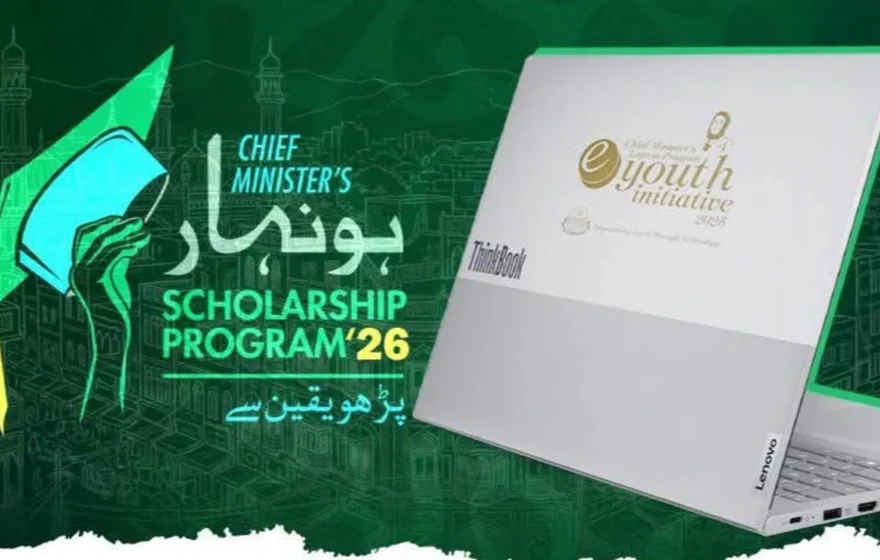
Punjab Chief Minister Maryam Nawaz Sharif attended a laptop and Honhaar Scholarship distribution ceremony at Pir Mehr Ali Shah Arid Agriculture University in Rawalpindi on November 24, handing out laptops and scholarships to students under the provincial government’s education initiatives. The ceremony was the latest in a series of distributions that have now reached students across Punjab and beyond, as the government presses ahead with two of its flagship programmes for young people in higher education.
The event marked the twelfth ceremony in the series. According to the government, 3,562 laptops were distributed among students of federally chartered universities in Islamabad, while 451 students received Honhaar scholarships worth Rs41.48 million. The laptops being handed out are modern 13th-generation Core i7 machines, a specification chosen so that students can use them for assignments, online research and digital learning rather than treating them as a basic device. For many of the recipients, it was the first personal computer they had ever owned.
Speaking to students at the ceremony, Maryam Nawaz said the laptops had been awarded on the basis of merit and hard work, and she urged recipients to accept them with pride. She said students did not need to thank the government for receiving the laptops, as access to educational resources was their right. The chief minister said the Punjab government wanted to ensure that no child was deprived of education because of financial difficulties. She added that if parents could not afford educational expenses and their children were forced to abandon their studies, it would represent a major failure of the government.
The two schemes have grown well beyond their original size. The Honhaar Scholarship Programme began with 30,000 scholarships in its first phase, and the chief minister later raised the allocation to 50,000. In the second phase, 20,000 more students received scholarships, and in the third phase 53,488 deserving and talented students were awarded support. Taken together, scholarships have been awarded to 108,000 students across the first three phases. The laptop scheme has followed a similar path. It began with 40,000 laptops and has since been increased to 112,000, with 48,292 laptops distributed so far among students in different districts of Punjab.
The programme has also reached beyond Punjab’s borders. A total of 5,000 scholarships have been allocated to students from other provinces and regions, including 517 for Azad Kashmir, 479 for Gilgit-Baltistan, 938 for Balochistan and 3,135 for Khyber Pakhtunkhwa. At a ceremony at COMSATS University in Attock earlier this month, students from Swabi in Khyber Pakhtunkhwa were among the beneficiaries, and they thanked the Punjab government for extending the scholarship beyond provincial boundaries. They said the financial assistance had helped them pay semester fees amounting to nearly Rs200,000, a sum that would otherwise have been out of reach. At that event, 6,161 laptops were distributed across the Rawalpindi division, and 2,590 scholarships worth Rs196.97 million were awarded to students in the division.
The laptop scheme itself is a revival. A previous government had discontinued it, and the current administration has brought it back and expanded it. The Honhaar Scholarship Programme covers students enrolled in public and private universities, federally chartered universities, BS colleges, special education institutions and medical and dental colleges, so it reaches a wide range of institutions rather than a single type of student. The scholarships pay tuition fees for deserving undergraduate students, while the laptops are meant to give them a proper machine for study. Between them, the two schemes address the two costs that most often decide whether a student completes a degree: the fees and the equipment needed to learn.
The scale of the two programmes also says something about how the Punjab government sees education spending. Handing out a laptop is a visible act, and a scholarship cheque is a measurable one, but the political argument behind them is that a province that cannot keep its talented students in classrooms will lose them to other pursuits. The chief minister’s message at Rawalpindi, that students should take the laptops as their right rather than as a favour, was aimed at that point: the state, in her telling, is meeting an obligation rather than handing out a gift.
What happens next will depend on delivery rather than announcements. More than 60,000 of the 112,000 laptops are still to be distributed, and the scholarship programme will need further rounds if it is to keep pace with each new cohort of students. The students who missed this round will be watching the Punjab Higher Education Department for the next application window, and the pace at which the remaining devices reach campuses in other divisions will show whether the scheme can sustain the scale it has promised. For the students who received their laptops in Rawalpindi, though, the question is simpler. They now have a machine and, in many cases, a scholarship to go with it, and the government that gave them both will be judged on whether the support continues once the ceremonies are over.
