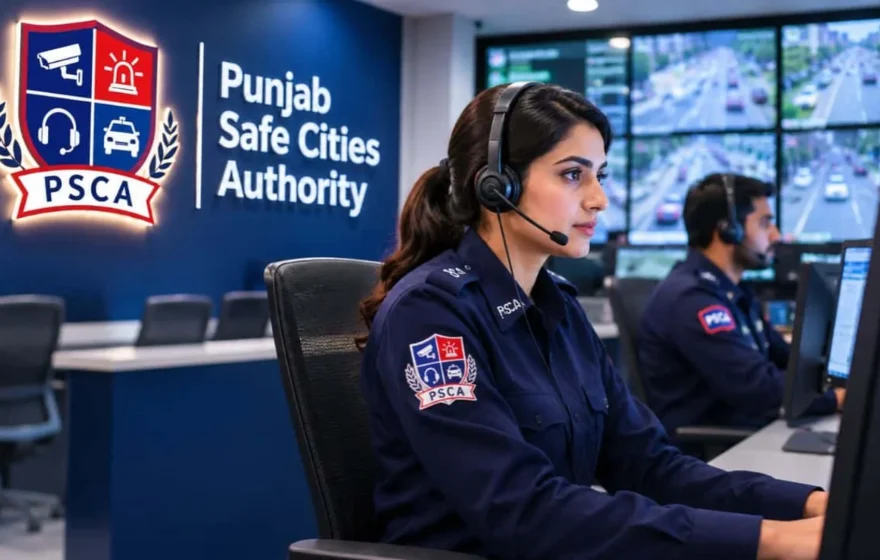
The Punjab Safe Cities Authority has said it is preparing to recruit Police Communication Officers, opening the prospect of new jobs for people who want to work at the centre of emergency communication and public safety in the province. The authority has not yet published a formal advertisement, but it has confirmed that the posts are being prepared and that further information about the recruitment process will follow. For now, the announcement is best understood as an early signal rather than an open application window, and interested candidates will need to wait for the official advertisement before they can judge whether they are eligible or how to apply.
What has not been disclosed yet is just as important as what has. The authority has not said how many Police Communication Officer posts will be available, what educational qualifications will be required, what age limits will apply, what salary package will be offered, or when applications will close. None of those details can be stated reliably at this stage, and any figure appearing elsewhere should not be taken as part of this recruitment round unless the authority itself confirms it. The authority has encouraged candidates to follow its official announcements for the coming details. No one should make plans, pay a fee to an agent or assume they qualify until the formal advertisement appears.
The role itself is well established within the authority, and its importance is easy to explain. Police Communication Officers are the people who sit between the public and the emergency response system. In earlier official descriptions of the post, their work has been described as receiving and processing requests for police and emergency help through electronic means of communication, watching live footage from surveillance cameras, and coordinating and dispatching police and other emergency resources through software, applications and audio and video links. They act as a bridge between the police and the public in emergencies and crises. It is a job that depends less on physical presence at a scene and more on judgement, communication and the ability to stay composed while several things are happening at once.
That work takes place inside a system that Punjab has been building for more than a decade. The Punjab Safe Cities Authority was established under legislation passed in 2015 to build and run an integrated command, control and communication system, known as the IC3 centre, in the province’s major cities. Lahore was the first and remains the hub of the network, with its command centre at Qurban Lines, where operators monitor camera feeds, take emergency calls and pass information to police units on the ground. The system was integrated with the police emergency helpline, 15, so that a call from a citizen in distress could be matched with what cameras in the area were showing and with the nearest available response. From Lahore the idea has spread across Punjab, with similar projects in Rawalpindi, Faisalabad, Multan, Gujranwala, Sargodha and Bahawalpur, as well as Kasur, Nankana, Sialkot and Sheikhupura, and an integrated network now covering dozens of cities.
Technology is central to that expansion, and it shapes what a Police Communication Officer is expected to do. The network relies on closed-circuit cameras placed at busy roads, markets, transport hubs and other public places, together with automatic number plate recognition cameras that can identify vehicles and support the electronic challan system for traffic offences. Artificial intelligence tools are increasingly used to help operators spot suspicious activity, although the final decisions about dispatching police or rescue services still rest with people. Callers to 15 can now also share a live phone video feed with the control room where no fixed camera is installed. Communication officers now work with far more information than a telephone call alone, but they must also be able to judge which information matters and act on it quickly.
The timing of the planned recruitment fits that wider picture. A larger network, covering more cities and handling more calls and camera feeds, needs more operators, and it needs them working in shifts around the clock, because emergencies do not keep office hours. Earlier recruitment for the same post involved written and skill tests, and candidates were expected to show that they could handle calls, enter information accurately, monitor systems and coordinate with field teams under pressure. The work suggests the authority will again look for people who communicate clearly, use computer systems confidently, keep accurate records and remain steady under pressure. For now, hopeful applicants should watch the authority’s official announcements, prepare the documents they are likely to need, such as educational certificates, a national identity card and a domicile, and avoid paying anyone who promises a post in advance. The announcement deserves attention but should not be overstated: no posts have been advertised yet and no deadline has been set. If the advertisement that follows is clear and timely, it will give applicants a fair chance to compete for roles that genuinely matter to public safety.
