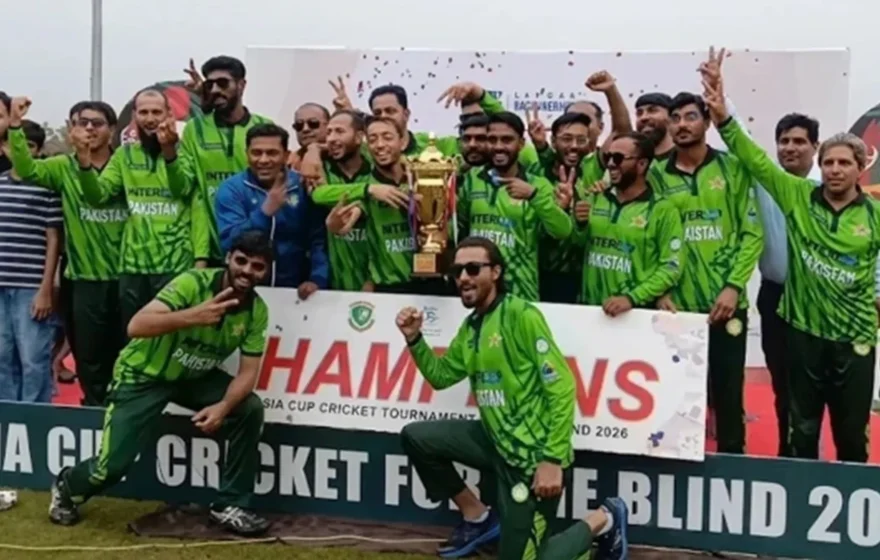
Pakistan have won the Blind T20 Asia Cup after rain washed out the final against India in Bangladesh, with the trophy awarded to the team on the strength of their superior record across the tournament. Not a single ball was bowled in the title decider in Dhaka, yet Pakistan walked away as champions because they had finished the league stage unbeaten and ahead of their arch-rivals on every tie-breaker that mattered.
The match referee declared Pakistan the winners under the tournament rules after persistent rain made play impossible. Those regulations had been shared with every participating team before the competition began, and they were clear about what would happen if the final could not be played. Pakistan ranked ahead of India on points, on net run rate and on the head-to-head record, so the title went to the side that had earned it over the course of the week rather than to a winner decided on the day.
It was, in many ways, a fitting reward for the most consistent team in the competition. Pakistan began their campaign with a commanding 126-run victory over hosts Bangladesh. They followed that with a 10-wicket win over Sri Lanka, a performance that underlined the depth of their batting and the discipline of their bowling. The toughest test came against India, and Pakistan passed it in the most dramatic fashion possible, scraping home by a single wicket in a match that went down to the wire. Three matches, three wins, and a place at the top of the standings.
India, the defending champions, recovered from that defeat to beat Bangladesh by eight wickets and book their place in the final, setting up a second meeting with Pakistan in the space of a few days. The rematch promised to be the highlight of the tournament. Instead, the weather had the final say. The rain that settled over Dhaka refused to lift, the ground staff could do nothing with a sodden outfield, and the officials were left with no choice but to call the match off and apply the rules as written.
What followed was less dignified than the cricket that had gone before it. The Indian team boycotted the award ceremony and left the stadium, and the Cricket Association for the Blind in India condemned the decision in strong terms. The association alleged that the World Blind Cricket Council's technical committee had initially agreed to declare both teams joint winners, only for council president Syed Sultan Shah, who also heads the Pakistan Blind Cricket Council, to overturn that agreement and hand the title to Pakistan alone. The claim has added a bitter edge to a triumph that Pakistan's players had earned on the field.
The ceremony itself went ahead without the Indian team. Bangladesh Cricket Board director Abdullah Al Fuad attended as the chief guest and presented the awards, while Rangpur Riders director Shehzad Akbar Subhan and Pakistan's high commissioner to Bangladesh, Imran Haider, were also present. For the Pakistani players, the moment still mattered. They had travelled to Dhaka with a point to prove, and they were leaving with a trophy, even if the final itself had never happened.
The tournament was the second edition of the Blind T20 Asia Cup, held in Dhaka from November 14 to 20, with five teams taking part: hosts Bangladesh, Pakistan, India, Sri Lanka and Afghanistan. Pakistan's 17-member squad was led by captain Nisar Ali, with Badar Munir as his deputy, and the side mixed experienced campaigners with several new faces. The players were confident, the management was ambitious, and beating India was openly described as the match that mattered most.
That confidence was rooted in a proud history. Pakistan are one of the great powers of blind cricket, with two 40-over World Cup titles, won in 2002 and 2006, and a Blind T20 World Cup triumph as recently as 2024. They were runners-up in the inaugural Blind T20 Asia Cup in 2015, and they have reached the final of every 40-over Blind World Cup ever played.
Blind cricket is played with an audible ball, and players are graded by the extent of their sight loss into B1, B2 and B3 categories, with each team required to field a set number from each group. The format demands the same skills as the sighted game, timing, placement, pace and nerve, adapted to players who rely on sound as much as sight.
For Pakistan, the Asia Cup title is another line in that record, even if the ending was unsatisfying. They beat every team they faced, they topped the table, and they won the only match that mattered against India. The manner of the victory will be argued over, but the trophy is in Pakistan's hands. The challenge now is to carry this form into the next global event, where the rivalry with India will be renewed and where, everyone involved will hope, the weather stays out of the way.
