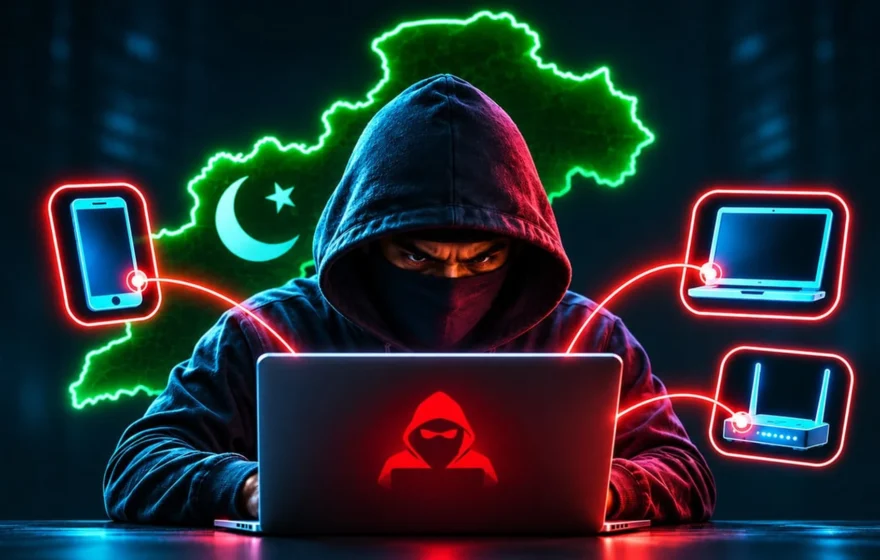
Backdoor cyberattacks in Pakistan surged by 50 per cent over the past year, according to cybersecurity firm Kaspersky, which detected more than 233,000 attempts to plant remote-access software on devices across the country between November 2025 and October 2026. The figures were shared at the company's Cyber Threat Intelligence Summit 2026 in Islamabad, where it also reported more than 9.4 million device-based and web-based attacks blocked in Pakistan over the same twelve months.
A backdoor is one of the quieter weapons in a hacker's kit, and that is what makes it dangerous. Unlike a virus that crashes a computer, a backdoor is a hidden entry point, usually planted through a malicious download, a compromised attachment or a fake software update. Once it is in place, the attacker can return whenever they like, browse files, copy passwords, or install further malware, often without the owner ever noticing.
Of the 9.4 million attacks Kaspersky recorded in Pakistan over the year, more than 6.3 million were aimed at devices themselves and more than 3.1 million came through the web. Almost one in four of the company's users in the country, 24 per cent, ran into a device-related threat, while 15 per cent encountered a web-based attack. The older style of attack is fading, though: exploit attacks fell by 8 per cent to just over 448,000.
How Backdoor Attacks Threaten Users
A backdoor gives a criminal unauthorised access to a compromised computer, letting them manage its files from a distance and steal whatever personal or sensitive information it holds. Kaspersky reported a sharp increase in these attacks even as some other categories of cyber threat declined, a sign that attackers now prefer the method that gives them the longest and least visible stay inside a victim's system.
For an ordinary user, that is a troubling prospect. A backdoor turns a personal laptop or phone into an open door: banking logins, family photographs and office documents are all within reach, and the intruder can sit quietly for weeks, collecting what they want. The infection often arrives disguised as something routine, and since phishing pages still reach 15 per cent of users, a single careless click can be all it takes.
Seven Cyber Threat Groups Monitored
Beyond the everyday criminal, Kaspersky said it monitored the activity of seven Advanced Persistent Threat groups operating in Pakistan, including one known as SideWinder. These are organised, well-resourced operations aimed at government bodies, companies and sensitive information, a very different proposition from opportunistic hackers chasing quick money.
SideWinder has been watched by security researchers since at least 2012, and Pakistan has long been its main focus. Its campaigns rely on spear-phishing, emails that impersonate trusted institutions to trick officials into opening malicious documents. In April 2026, Pakistan's National Cyber Emergency Response Team warned of one such campaign, in which fake websites mimicking the defence and finance ministries and the CERT itself were used to steal credentials. The group is widely described by security firms as a suspected Indian-origin operation, though no government has formally attributed it.
The company also warned that ransomware and supply chain attacks remain major concerns, particularly when attackers exploit trusted business relationships. Compromise one supplier or business partner and the attacker can ride that trust straight into the real target. Between April and September 2026, Kaspersky detected more than two million attempts worldwide to use hacking tools.
AI Is Making Cyberattacks More Sophisticated
Artificial intelligence is now accelerating the threat. Kaspersky warned that AI is helping cybercriminals develop malicious tools faster and adapt their attacks more efficiently, cutting the time and cost of preparing an attack. A convincing phishing email that once took a skilled operator hours to write can now be produced in seconds, in any language.
Youssef Abdelmonem, a senior security researcher at Kaspersky's Global Research and Analysis Team, said attackers increasingly exploit legitimate software, trusted business relationships and AI-powered tools. He advised organisations to adopt advanced systems such as Kaspersky Next EDR and XDR, which watch for suspicious behaviour across devices and networks, and stressed employee security awareness and training.
The warning lands at a moment when Pakistan is visibly stepping up its own response. On the same day the figures were released, the National Cyber Crime Investigation Agency launched a new Cyber Info App that lets people report online scams, financial fraud and hacking directly from their phones, with an emergency button and access to the agency's helpline, 1799. The agency has been active in recent weeks, arresting 154 people in raids on illegal call centres on 14 November.
The deeper message of Kaspersky's figures is that cyberattacks in Pakistan are becoming quieter and smarter rather than louder: a hidden door left open, a trusted name copied onto a fake website, and an AI-written email that reads exactly like the real thing. Defence has to change with it, from reacting to infections towards watching for hidden access and treating unexpected links with suspicion. The 50 per cent jump in backdoor attacks is a warning that the front line is now the ordinary device sitting on every desk and in every pocket.
