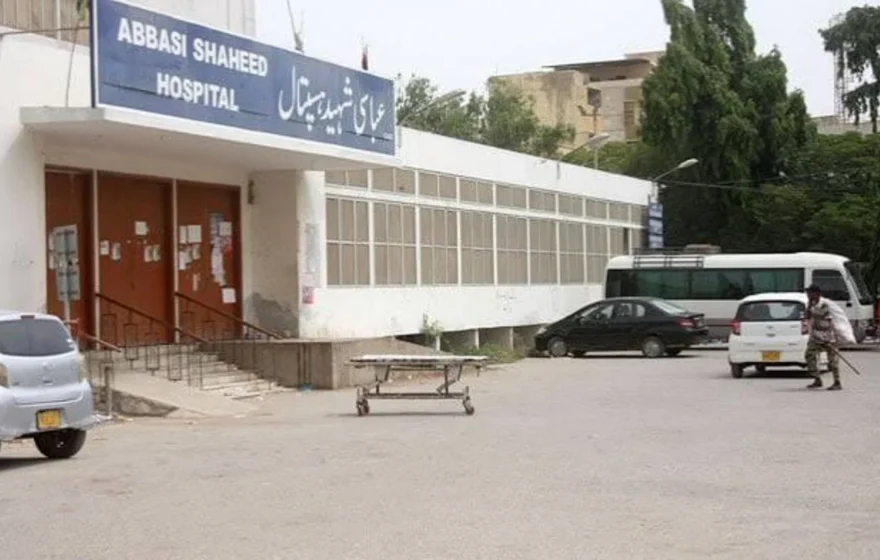
A new medical block at Karachi’s Abbasi Shaheed Hospital has been completed after 52 years, in a development that could ease pressure on one of the city’s busiest public hospitals and bring a wider range of specialist care closer to the people of District Central. The project was carried out jointly by the Sindh government and the Karachi Metropolitan Corporation, the civic body that runs the hospital, and the new building is expected to be formally inaugurated next week. Once it opens, patients from District Central and other parts of Karachi are expected to benefit, although hospital managers say services will be introduced in stages rather than all at once.
The scale of the new block is considerable. It is a ground-plus-three-storey building, covering 200,000 square feet, with room for between 150 and 200 beds. It is intended to function as a multi-purpose facility, offering treatment for conditions affecting the digestive system, the heart, the lungs and the skin, alongside outpatient services across a range of specialties. Modern diagnostic services will also be available on site, including X-rays, echocardiography, which uses sound waves to examine the heart, and endoscopy, which allows doctors to look inside the body using a thin, flexible instrument.
Karachi Metropolitan University Registrar Mahmood Ahmed Khan, speaking about the project, described the block as a multi-purpose healthcare facility, and hospital administrators have stressed the idea of bringing several services under one roof. That phrase matters for patients in a city where a single illness can otherwise mean separate trips to separate hospitals for a consultation, a scan and a follow-up. If outpatient clinics, diagnostic testing and treatment are genuinely available in the same building, families may save time, transport costs and repeated waiting, which in a low-income district can be the difference between seeking care promptly and putting it off. Plans are also under consideration to provide medical facilities for children with autism and for persons with disabilities, groups whose needs are often overlooked in crowded public hospitals.
To understand why this completion matters, it helps to know something about the hospital itself. Abbasi Shaheed Hospital, in the Paposh Nagar area of Nazimabad, was built in 1974, during the government of Zulfikar Ali Bhutto, and was named after Major Ziauddin Abbasi, who lost his life in the 1965 war between Pakistan and India. It was intended to serve the people of northern Karachi, including Nazimabad, North Nazimabad, North Karachi, Federal B Area and Orangi Town, an area home to close to a million people, so that residents would not have to travel across the city to Jinnah Hospital or Civil Hospital for treatment. Today it is the city’s third largest government hospital after those two institutions, and it serves as the teaching hospital for Karachi Metropolitan University, formerly Karachi Medical and Dental College, which means it trains future doctors as well as treating patients.
That long history also explains the sense of a project long overdue. By the time the hospital marked its fiftieth anniversary in November 2024, Karachi’s mayor had spoken frankly about its deterioration over five decades, while also pointing to a revival under way, with orders to reopen wards that had fallen out of use and to restore departments that had closed. In the years since, the hospital has seen a series of improvements, including renovated trauma, laboratory and gynaecology facilities, a reopened school of nursing, a restored morgue and a haemophilia treatment centre opened in early 2025. Affordable services have also been highlighted, including CT scans offered at a low price. The new block fits into that wider effort to bring a historic but run-down institution back to full working order, rather than standing alone as a single new building.
The phased opening deserves attention, because it is where many public projects succeed or falter. Hospital administrators say the facility will be made operational in stages, so that patients can gradually access multiple services under one roof. A phased approach can be sensible: it allows staff to be recruited and trained, equipment to be installed and tested, and early problems to be fixed before the building is running at full capacity. It also, however, requires clear communication with the public. Patients who arrive expecting a full service on day one may be disappointed if only some clinics are open, and the benefit of the new block will depend on how quickly the promised specialties, diagnostics and outpatient services actually become available in practice.
For District Central, the stakes are straightforward. Public hospitals in Karachi serve large numbers of lower- and middle-income families who cannot easily afford private care, and Abbasi Shaheed Hospital has long been a vital resource for that population. A new block with up to 200 beds, modern diagnostics and specialist outpatient clinics could shorten waiting times, reduce referrals elsewhere and give doctors a better base for teaching the next generation of medical students. But a completed building, properly staffed and equipped, is a tangible step, and for the patients who will walk through its doors next week and in the months that follow, that step may matter a great deal.
