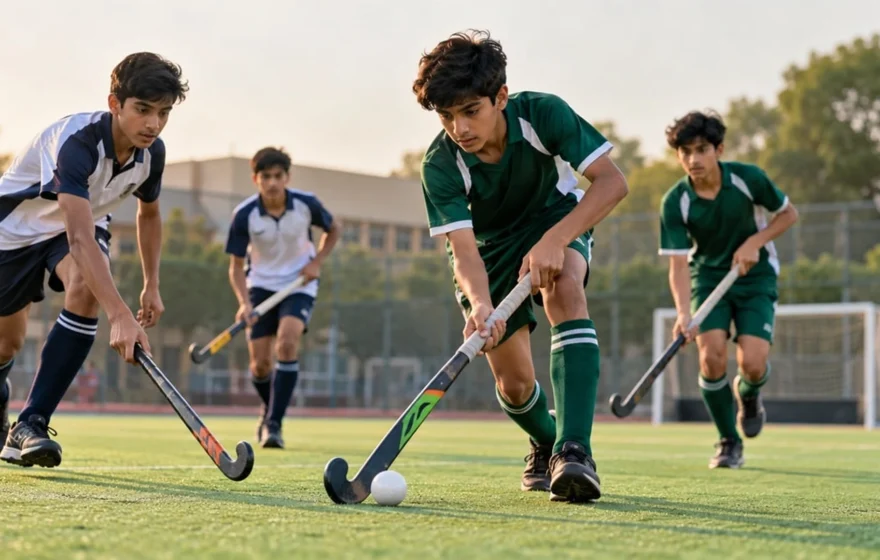
The Pakistan Hockey Federation has unveiled plans for a nationwide Schools Hockey League that will begin on November 15, a move to rebuild the sport from the ground up and give schoolchildren a route towards the national teams. The announcement matters beyond a single tournament: hockey was once the pride of the country and is still formally its national game, yet has struggled to find new players and steady funding.
Under the plan, the competition will start at school level and work upwards. Matches at tehsil, district and divisional level will be played at the same time across the country. Those rounds will be followed by provincial competitions in January, and a national round in February. The structure is wide at the base and narrow at the top, allowing many school teams to enter while still producing a national champion and a group of standout players for selectors to watch.
The initiative was discussed at a consultative meeting in Islamabad on Tuesday, chaired by Mohiyuddin Ahmed Wani, who serves as secretary of the Inter-Provincial Coordination Division and as chief of the Pakistan Hockey Federation. Representatives from the education and sports departments of all four provinces attended, along with officials from Azad Jammu and Kashmir, Gilgit-Baltistan and Islamabad. During the meeting, Wani urged officials to treat the league as a national responsibility, pointing to Pakistan’s past achievements and the sport’s standing as the national game.
PHF focal person Ehtasham Anwar briefed the participants on the organisation. The competition will operate under the federation, with a dedicated chief executive officer and a steering committee headed by the federation’s president, giving schools, provinces and sponsors a fixed point of contact and a structure that can survive beyond a single season.
The financial incentives are modest but meaningful for schoolchildren. Players from the top three teams will receive monthly stipends for one year: ten thousand rupees for the leading team, seven thousand five hundred rupees for second place and five thousand rupees for third. The winning team and selected players will also be offered opportunities for international tours, a prize young players often say they lack. For a teenager weighing hockey against other sports, a regular stipend and the prospect of travelling abroad can make the difference between staying in the game and drifting away from it.
The league will also honour school heads and sports teachers through special awards, recognising that a competition of this scale cannot run on players alone. Teachers arrange practice, manage travel, persuade parents and keep children motivated, and their work is rarely rewarded in public. Education is built into the design as well: each year, one hundred boys and one hundred girls will be selected for summer camps combining hockey coaching, fitness training and academic tutoring, addressing parents’ worry that sport comes at the expense of the classroom. The inclusion of girls is important in a sport where the women’s game has long received far less attention than the men’s.
The wider context explains why the federation is reaching for the schools. Pakistan’s hockey record remains extraordinary, with three Olympic gold medals in 1960, 1968 and 1984, four World Cup titles in 1971, 1978, 1982 and 1994, and a bronze medal at the Barcelona Olympics in 1992 that remains the country’s last Olympic hockey medal. Since that 1994 triumph, however, the decline has been steep. Pakistan failed to qualify for the Olympics in 2016, 2020 and 2024, and missed the World Cup in 2014 and 2023, a fall linked to weak domestic competition, the loss of departmental teams that once gave players jobs and security, the high cost of synthetic turf, and the pull of cricket for sponsors and young athletes.
That history is why a schools league, if sustained, could matter more than another short-term camp or one-off tournament. A regular competition creates fixtures, rivalries and a reason for schools to keep hockey in a child’s life year after year. It gives selectors a much larger pool to draw from, and it gives provinces a shared calendar to plan around, something the representatives pledged to do by aligning their sports calendars with the league’s schedule. Cooperation of that kind is easy to promise and harder to deliver across provinces and territories, but without it the national round in February would mean very little.
Questions remain that only the first season can answer. The federation will need to show that matches take place on time, that stipends reach players in full, that girls’ teams receive the same organisation as boys’ teams, and that the summer camps offer real coaching and tutoring rather than a brief showcase. Funding, facilities and qualified coaches will all be tested, particularly in smaller towns where hockey infrastructure is thin. Yet the plan recognises the central lesson of Pakistan hockey’s decline: talent has never been scarce. What has been missing is a reliable system that finds talent early, keeps it in the sport through school, and carries it towards the national team. If the league can become that system, November 15 may be remembered as the day Pakistani hockey began to rebuild itself.
