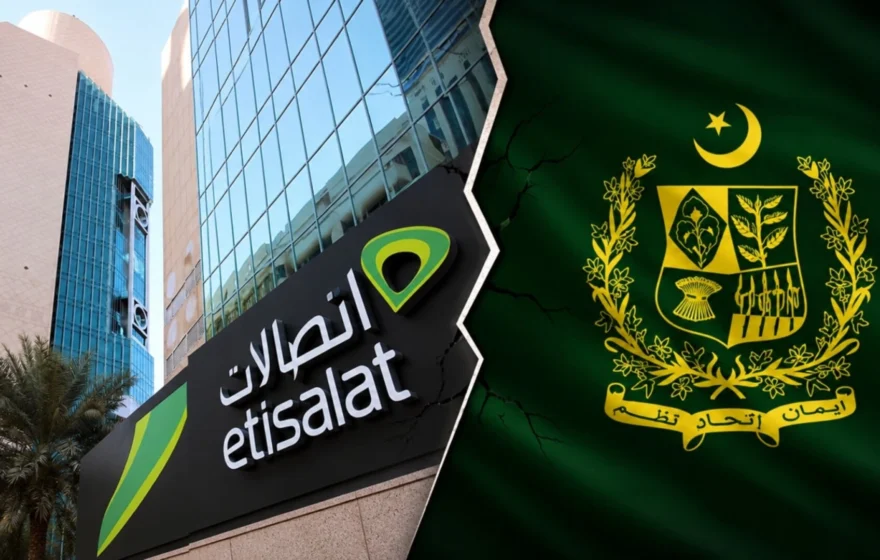
Pakistan is preparing to take its long-running dispute with the United Arab Emirates telecom company Etisalat to international arbitration, in a fresh attempt to recover $800 million unpaid since the privatisation of Pakistan Telecommunication Company Limited more than twenty years ago. The move would end years of committees and negotiations that have failed to settle one of the country’s most stubborn privatisation disputes.
The dispute dates back to 2005, when Etisalat bought a 26 percent stake in PTCL, together with management control, for $2.59 billion, one of the largest privatisation transactions in Pakistan’s history. It gave the Abu Dhabi-based company effective control of what was then the country’s telecom monopoly, despite holding only a minority shareholding. Pakistan received $1.76 billion, but the remaining $800 million was withheld over the transfer of properties supposed to pass to PTCL as part of the deal.
That property question has proved remarkably difficult to close. Of the 3,246 properties involved, about 99 percent have now been transferred, but 32 remain outstanding, and Etisalat has pointed to those as the reason for holding back the payment. Pakistan argues those properties cannot be transferred for ownership reasons: some belong to provincial governments, some are only partly owned, and some were never owned by PTCL. The gap has never been bridged, even though the disputed properties have been estimated at far less than $800 million.
The latest push came up during a joint meeting of the Senate standing committees on information technology and privatisation on Tuesday. Officials told the committees that the federal cabinet had directed the Office of the Attorney General for Pakistan to move forward under Rule 24 of the Rules of Business, 1973.
Pakistan Weighs Legal Action Over the PTCL Privatisation Dispute
According to the Privatization Division, the government has tried repeatedly to resolve the dispute through committees and direct talks with Etisalat since 2015, without success. That record led to another committee in July 2026, headed by the prime minister’s adviser on privatisation and including representatives from the information technology and law ministries and the attorney general’s office.
After nearly two decades of deadlock, that committee recommended international arbitration under the share purchase agreement, seeking not only the unpaid $800 million but also its opportunity cost since 2008, when the payments fell due, together with applicable damages. It asked the attorney general to assess the strength of Pakistan’s legal position and the likely consequences before any formal step, and recommended that the prime minister’s or the federal government’s approval be obtained before a Notice of Intent is issued to Etisalat, provided arbitration is considered legally viable. The Privatization Division then submitted a summary to the federal cabinet, setting the current process in motion.
Previous settlement attempts have come close but never closed. In 2022, Etisalat offered $263 million, which Pakistan rejected as only about a third of the outstanding amount. Earlier, Pakistan suggested deducting the value of the properties that could not be transferred, estimated by its officials at under $100 million, which would still have left most of the $800 million payable. Etisalat has put a much higher value on those properties, and the two sides have never agreed. No Pakistani government has previously taken the company to international arbitration, and the current move would break with that pattern.
There are also wider stakes for Pakistan’s privatisation programme. How the case ends will be watched by investors considering future state asset sales, since it will show whether agreements with the government are enforced when disagreements arise. A successful recovery would bring in funds while public finances remain under pressure, while a failed case could involve substantial legal costs, which is why the attorney general’s assessment matters so much.
Senators Raise Questions Over Secrecy Around the PTCL Sale Agreement
The Senate meeting also brought a separate concern into the open: lawmakers said they had not been able to see the original share purchase agreement governing the sale of a national asset, even though officials had access to it. The joint session, chaired by Senator Dr. Afnanullah Khan and Senator Palwasha Khan, turned tense when IT Secretary Zarrar Hasham Khan described the matter as sensitive and asked unauthorised participants, including journalists, to leave before discussion continued behind closed doors.
Several senators questioned why elected representatives should be kept from a document that shaped the transfer of a major public company, and called for stronger parliamentary oversight of privatisation deals. When state assets are sold, they argued, the terms should be open to parliamentary scrutiny, not held only within government departments. The secrecy has also made it harder for lawmakers to judge whether the property dispute justifies withholding such a large sum.
For now, the process is still preparatory. The attorney general’s office has been tasked with carrying out the cabinet’s decision, and no Notice of Intent has yet been issued. The coming weeks will show whether the legal assessment supports a claim, whether final approval is given, and whether Etisalat offers a fresh settlement before matters reach a tribunal. After more than twenty years, the dispute may finally be heading for a decision, though a case begun now could still take years.
