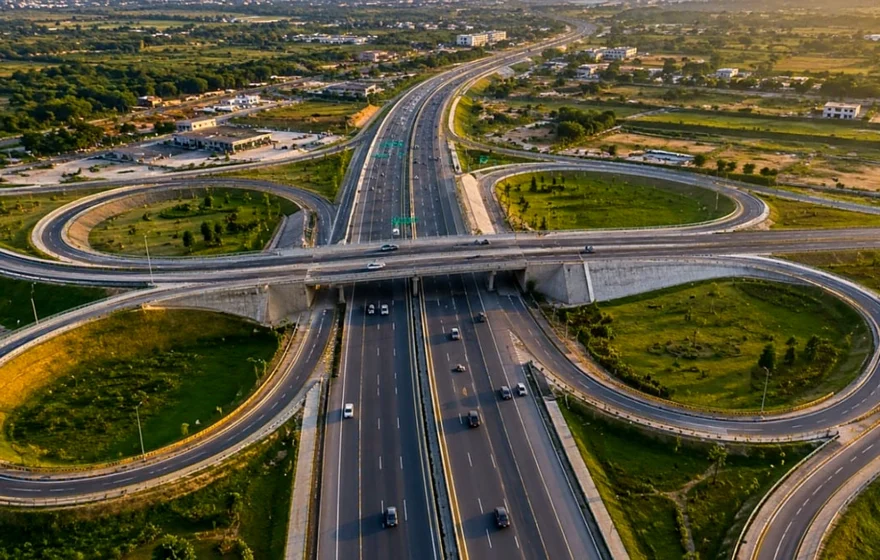
Rawalpindi’s long-awaited Ring Road will remain closed to general traffic for at least another month, as work on toll plazas, weighing stations and related systems continues. A senior district administration official said the provincial government would announce a formal inauguration only after the remaining facilities were complete, and warned that the outstanding work could take a month or longer. The latest setback adds to a history of delays for a project that has been promised, redesigned and restarted over several years, and it means commuters and freight operators who had hoped for an early opening must wait a little longer.
At the heart of the delay are eight weighing stations planned for heavy trucks. Authorities intend the stations to measure vehicle weight and calculate toll charges, a step officials describe as essential before heavy and light traffic can safely use the road together. Workers are also building toll plaza booths at Baanth and Thalian, while procurement of the weighing machines themselves remains incomplete. The official estimated that building the weighing stations would take two to three weeks, after which installation of the machines would begin.
Once the weighing equipment is in place, the Punjab Ring Road Authority will need about another two weeks to install its Intelligent Transportation System and electronic toll collection system. Sensors in that system will weigh trucks and determine their toll charges, linking enforcement and payment in a single process. Alongside the technical work, the authority is setting up its own offices and building residential accommodation for staff who will operate and maintain the route. Only when those facilities are operational, the official said, will the road be ready to open to heavy and light traffic.
Work on the Thalian interchange will follow, rather than precede, the opening. The official said construction there would begin after the Ring Road was opened to traffic, with completion expected by December. That sequencing helps explain why officials are reluctant to name a firm opening date: the core route may be usable before every interchange is finished, but the supporting systems must be in place first. For drivers, the distinction matters, because an opening without tolling and weighing in place could undermine both revenue collection and road safety.
The road itself is designed to a substantial standard. It has cost Rs. 50.4 billion, has a design speed of 120 kilometres per hour, and features six lanes with controlled access, five interchanges and a 90-metre right of way. Its infrastructure includes two bridges across the Soan and Sill rivers, another 12 bridges crossing various nullahs and roads, a railway bridge near Baanth and 11 overpasses. Taken together, those features are intended to give Rawalpindi a faster, more direct orbital route, easing pressure on inner-city roads that currently carry a mix of local, regional and through traffic.
That purpose helps explain why the project has remained politically important despite its troubled history. During the Pakistan Tehreek-e-Insaf government’s tenure, planners proposed a 68-kilometre Ring Road. A financial scandal then halted work, and the alignment was subsequently revised to 38.3 kilometres. Then-prime minister Imran Khan laid the foundation stone in March 2022. Later, the Pakistan Democratic Movement government, led by Shehbaz Sharif, temporarily suspended the project before authorising work again after a third-party validation of the revised route from Baanth to Thalian. Prime Minister Shehbaz Sharif then laid the foundation stone at Rawat on 8 August 2023.
For residents, the stakes are practical rather than abstract. A functioning ring road should, in principle, shorten journeys around the city, keep heavy vehicles away from congested streets where possible, and make freight movement more predictable. Weighing stations are a central part of that logic: overloaded trucks damage road surfaces, increase maintenance costs and raise safety risks, so checking weight before tolling is presented as a way to protect the investment as well as road users. Similarly, electronic toll collection is meant to reduce queues at plazas and make charging more transparent, although its benefits will only become clear once the system is running at scale.
The latest delay therefore does not, on its own, suggest that the project has stalled, but it does underline how much remains to be done after the main carriageway is built. Toll booths, weighing equipment, intelligent systems, offices and staff accommodation are not cosmetic additions; they are the machinery that allows a modern controlled-access road to operate fairly and safely. Until they are finished, the provincial government appears unwilling to set an inauguration date that it might have to move again. Rawalpindi’s motorists will be watching the next few weeks closely, hoping that the timetable described by the district administration — weeks for the weighing stations, followed by two weeks for the transport and toll systems — holds, and that this latest month-long wait is the last one before the road finally opens.
